




Instagram content in 2026 is less about “being consistent” and more about understanding how reach is earned.
Every post is tested fast. If people don’t stay, swipe, or share, distribution stops. That’s why so many accounts feel stuck even when the content is genuinely useful. The idea isn’t the content you’re trying to put out. Instead, it is the packaging and format you’ve opted for.
So instead of treating Instagram like a place where you “post whatever you have today,” you need a repeatable Instagram content system. One that tells you exactly what to post on Instagram in 2026, why each format works, and how the pieces support each other.
In this guide, I have given you a practical plan built for current behavior: Reels for discovery, carousels for saves, Stories/community for retention, and a simple weekly loop to repeat what’s working. There are no hacks or tricks. Just a system you can run every week without turning Instagram content growth into a full-time job.
Let’s dive right in!
TL;DR:
Instagram Growth System for 2026: Instagram rewards content people stick with and content people send to someone else. So the simplest system is: use Reels to get discovered (unconnected reach), use carousels to earn saves and deeper engagement (connected reach + repeat distribution), use Stories/community to stay top-of-mind (retention), and then run a weekly loop where you repeat what worked instead of guessing your way into burnout.
You’re not imagining it. The platform changed.
Instagram moved from chronological feeds to engagement-based ranking to what we have now: interest-based distribution. The metric that determines success shifted three times in three years.
2022: Likes and comments mattered most.
2024: Saves and shares took over.
2026: Watch time and completion rate dominate.
The Before and After of Instagram Content!
| What Worked Then | What Works Now |
|---|---|
| Aesthetic product photos | Behind-the-scenes content |
| 30 hashtags per post | 3-5 relevant tags |
| Likes as success metric | Saves and shares |
| Daily posting | Strategic 3-5x/week |
| Beautiful grid | Valuable content |
To summarize:
Here’s the good news though: when you fix Instagram content packaging and you stop treating every post like a one-off, growth becomes less random.
Instagram is not sitting there judging your creativity. It’s watching what people do. If your post creates quick “good behavior,” it gets pushed wider. If it creates “scroll behavior,” it gets cut off early. That’s it.
Instagram’s head, Adam Mosseri, confirmed this publicly. The algorithm ranks content based on three primary signals. In order of priority.
This is the most important ranking factor for Instagram content in 2026.
Instagram wants users scrolling for hours. That’s possible when the content that keeps the user watching gets distributed more.
For Reels, that usually depends on the hook and how long people keep watching. For carousels, it’s whether people swipe, pause, and actually consume the slides.
For video content, completion rate also beats duration. A 90-second reel where people quit at 15 seconds is worse than a 10-second reel they watch completely.
What this means for you: Don’t make content longer. Make it worth watching to the end.
Instagram tracks how often people send your content to friends.
694,000 Reels get shared per minute globally. That’s the strongest distribution signal the algorithm sees because it proves person-to-person value.
When someone shares your post via DM, Instagram interprets it as “this content is valuable enough to recommend to someone I know.” This is why “relatable + useful” wins so often. It gives people a reason to pass it along.
What this means for you: Create shareable content over likeable content. Ask yourself, “Would someone send this to a colleague or friend?”
Saves are the cleanest version of this, but you’ll also see it in comments that are specific, DMs, profile visits, and people coming back to your account.
If your content leaves people with “okay that was actually helpful,” you’re playing the right game.
Also, one mindset shift that makes everything clearer: there are two kinds of reach.
You’re either getting connected reach (your followers) or unconnected reach (new people). Reels usually lead the second one. Carousels and Stories usually strengthen the first one. A real strategy uses both on purpose.
What this means for you: Make reference content. Tutorials, data compilations, templates, checklists. Stuff people want to come back to.
| Ranking Signal | Weight | What It Tells Instagram |
|---|---|---|
| Watch time | Highest | Content is engaging |
| Shares | High | Content has value |
| Saves | High | Content is useful |
| Comments | Medium | Content sparks discussion |
| Likes | Low | Basic acknowledgment |
Source: Instagram (Adam Mosseri), 2026
Now you know what the algorithm wants. Here’s how to give it to them.
You don’t need to post everything. You just need to know what each format is good at, so you stop using the wrong tool for the job.
Think of this like a small menu. You pick based on your goal that day.
Reels are still your best discovery lever. If you want new people to find you, this is the format that gives you the most surface area.
The mistake most brands make is thinking Reels need to be “entertaining.” They don’t. They need to be clear. A strong hook, one idea, one payoff.
Use Reels when your goal is:
A good mental model: Reels pull people in. They are not where you explain your entire philosophy.
Carousels are the most reliable format for “I want this later” behavior.
If Reels are the handshake, carousels are the actual conversation. They’re where you teach, break down, show steps, give templates, and earn the save. For carousels, every swipe is an engagement signal. Each slide = new interaction.
Use carousels when your goal is:
A simple test: if your post can become a checklist, framework, teardown, or template, it probably wants to be a carousel.
Stories don’t always “blow up,” but they quietly lift everything else.
They keep you familiar. They give people a low-friction way to interact. They make your audience feel like there’s a real person behind the account.
Use Stories when your goal is:
Stories are where you can be less polished. In fact, that usually helps. You can even use them to interact with your audience to know what kind of content they want to see more of. ✨ Here are some Instagram story content ideas you can follow.
Collabs form the borrowed distribution part of your Instagram content system. They are one of the fastest ways to reach new people without depending on luck.
The only requirement is: the audience should make sense, and the topic should be obvious. If your collab feels random, people will scroll. If it feels perfectly aligned, it will move.
Use collabs when your goal is:
If you do just add these 4 formats to Instagram content strategy with intention, you’ll already be ahead of most accounts that are posting blindly.
Now that you know about the Instagram content formats, let’s get specific about Reels.
Reels are still the clearest path to unconnected reach in 2026. If you want new people to find your Instagram profile, this is the format that gives you the biggest distribution surface.
But most “Reels advice” is annoying because it assumes you want to be a creator. That’s not always feasible. Instead, you want discovery without making trending reels that don’t make sense for your niche.
So here’s the simple way to think about Reels in your Instagram content strategy for 2026: a Reel is not where you teach everything. A Reel is where you earn attention for one idea. One sharp point. One clear payoff.
Every Instagram reel has one job: make someone stop scrolling and stay long enough to understand what you’re saying. That’s also why most reels fail because they start like a presentation. “Today we’ll talk about…” or “Here are some tips…”
But no one’s really asking for it. And Instagram can’t reward a Reel that people abandon in the first second.
Your first second of Instagram reel needs to do one of these:
Then your next 5–10 seconds have to deliver fast. No scene-setting. No long intro. No “let me explain the context.” Context can come later.
To get more views on your Instagram reels, you don’t need endless creativity. You need repeatable formats.
Here are the Reel types that work for brands, agencies, SaaS, ecom, and creators who don’t want to perform.
If you pick just 2–3 of these formats and rotate them, you’ll never run out of Reels ideas.
You don’t need fancy editing. You need a clean structure.
This is where a lot of people mess up. They end with nothing, and the Reel has no reason to be saved or shared.
If you’re building an Instagram content system for 2026, you don’t need 14 Reels a week.
Start with one of these:
Batching is the fastest content strategy to grow. One session, 4 Reels, done. Don’t make every Reel a full production.
If Reels are how people discover you, carousels are how they decide you’re worth following.
This is the format that quietly drives the best kind of engagement in 2026: the kind that says, “I’m saving this,” “I’m sending this,” or “I’m coming back to this later.” That’s also why carousels are such a cheat code for brands. You don’t need to be entertaining. You need to be useful, structured, and swipe-worthy.
✨ SocialInsider’s data proves it! Carousels get 0.55% engagement vs 0.50% for Reels and 0.45% for static posts. 1.4x more reach than single-image posts. 2x more saves than any other format.
Before creating carousels on Instagram, here’s what you need to remember: a carousel isn’t “10 slides of tips.” A good carousel is a guided experience. Every slide should work to earn the next swipe.
Carousels are crucial for Instagram content strategy because they force the user to pause, rather than swiping down the feed. And once someone swipes once, you’ve already won a small battle for attention. With each swipe, the algorithm also gets a new engagement signal. So, if someone swipes through your 7-slide carousel, Instagram interprets it as “this person is actively engaging with valuable content.” That’s seven signals vs one.
Also, carousels are naturally built for saves. And saves are basically “future attention.” That’s why a strong carousel can keep resurfacing and keep compounding, even if it doesn’t explode on day one.
So in your Instagram content strategy for 2026, carousels do two jobs:
Not every multi-image post is a good carousel. Here’s the checklist:
Carousel templates that work
You don’t need endless new ideas. You need formats you can reuse without getting boring.
Example: “How to Set Up Instagram Shopping (No Developer Needed)”
Example: “We Analyzed 10,000 Instagram Posts. Here’s What Gets Saved.”
Example: “How We Grew Our Instagram from 1K to 50K in 6 Months”
Example: “7 Instagram Algorithm Changes You Missed in 2026”
Here’s the secret: create one template, reuse it monthly. Design your carousel template once in Canva. Same fonts, same color scheme, same layout. Then just swap out the content each week.
You can also batch-create 4-8 carousels in one sitting. You’ll have a month of content ready.
Once you start posting carousels, use Vaizle’s free Instagram engagement rate calculator to check if your profile’s overall engagement improved or not.
At this stage, you don’t need more theory. You need a weekly operating system for your Instagram content strategy in 2026 that makes two things happen at the same time:
So your week needs discovery + depth built in, not “whatever I feel like posting.”
Most Instagram accounts should follow this split:
40% Reels (for discovery and reaching new audiences)
30% Carousels (for engagement and saves)
20% Stories (for daily community connection)
10% Static posts (for important brand moments)
This mix balances reach (Reels) with engagement (carousels) and community (Stories).
Here’s what a 4-post week looks like in practice:
| Day | Content Type | Reference Topic Example | Primary Goal |
|---|---|---|---|
| Monday | Carousel | “7 Instagram Algorithm Changes in 2026” | Educational value, saves |
| Wednesday | Reel | Quick tip: “How to find your competitor’s ad budget in 30 seconds” | Reach, shares |
| Friday | Carousel | “Our Week Behind-the-Scenes: What We Learned” | Humanize brand, engagement |
| Sunday | Reel | Reaction to trending marketing topic | Discovery, new followers |
Add Stories daily throughout the week (5-10 per day). Quick updates, polls, behind-the-scenes moments.
If you’re posting 5x per week, add one static post for a major announcement or professional photo.
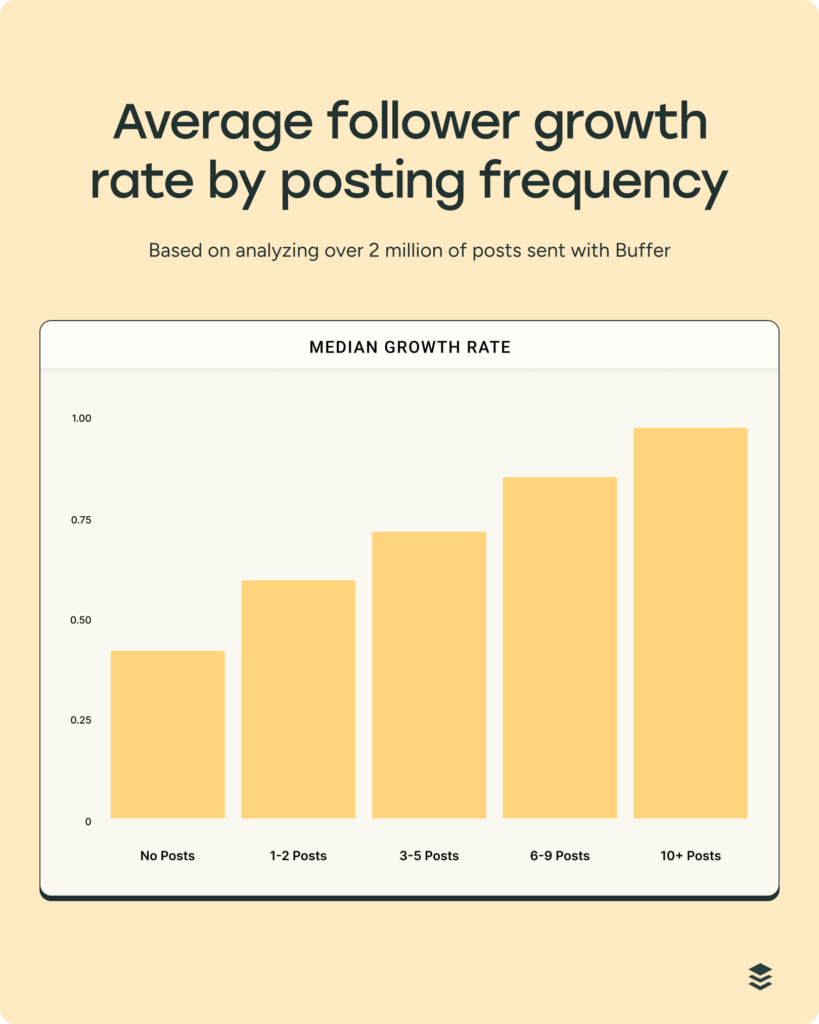
Everyone asks: how often should I post on Instagram?
The answer backed by data: 3-5 times per week.
Buffer analyzed posting frequency across thousands of accounts in 2026. Here’s what they found:
1-2 posts/week: Baseline growth (slow but steady)
3-5 posts/week: 2x follower growth rate compared to 1-2x
6-7 posts/week: Diminishing returns + team burnout risk
Daily posting: Only works for news/media brands with dedicated content teams
The sweet spot for most brands: 3-5 posts per week + daily Stories.
If you take one thing from this guide, make it this: Instagram growth in 2026 is a system, not a vibe. Once you stop guessing and start posting with roles, everything gets easier.
Run the same loop every week: Reels for discovery, carousels for saves, Stories/community for retention, and a simple weekly review to repeat what worked. That is the Instagram content system for 2026. You do not need more “ideas.” You need fewer decisions.
Want this system to feel 10x easier? Use Vaizle AI as your “idea engine”
You can build a solid Instagram content strategy in 2026 without tools. But if you run ads (or you have Ads Manager data), you’re sitting on a goldmine of proof that most creators never get. Vaizle AI helps you turn “what’s already working in your Meta account” into content topics, hooks, and carousel angles without staring at dashboards.
A simple way to use it with this framework:
Prompts you can literally copy:
Start with one topic you can talk about for 30 days. Then run it through formats: one Reel that makes a sharp point, one carousel that teaches the full breakdown, and Stories that show the “real life” behind it. Consistency beats variety when you’re starting.
If you want a simple answer: 3–5 posts/week is the sweet spot for most accounts. It’s enough volume to learn what the Instagram algorithm 2026 tends to reward, without turning content into a daily stress cycle.
Yes, because carousels are still the easiest way to earn saves and shares without being “entertaining.” If you’re a brand, marketer, or founder, carousels are your trust-builder. Treat them like swipeable tools: checklists, teardowns, templates, and before/after breakdowns.
Instagram’s 2026 algorithm ranks content based on three primary signals: watch time and completion rate (highest priority), shares via DM, and saves. It’s no longer chronological. Instead, it predicts what each user wants to see based on their past behavior and interests. The algorithm prioritizes Reels for discovery (35% of screen time) and carousels for engaged audiences. Hashtags have minimal impact now—focus on creating shareable, valuable content that people actually want to watch and save.
Reels get the most reach because Instagram allocates 35% of screen time to them. However, reach doesn’t equal engagement or conversions. Carousels get 1.4x more reach than static posts and higher engagement (0.55% vs 0.50% for Reels). For maximum reach, post educational or entertaining Reels. For engagement and community building, use carousels and Stories. The best strategy uses both formats for different goals: Reels for discovery, carousels for conversion.
The platform average is 0.48% in 2026. By format: carousels average 0.55%, Reels 0.50%, static posts 0.45%. Industry matters significantly—fashion brands average 1.1% while B2B/marketing brands average 0.54%. If you’re a B2B brand getting 0.5%+ engagement, you’re performing above average. Focus on saves and shares over likes—those metrics actually impact distribution and conversions.
Instagram no longer penalizes short Reels. Optimal length: 7-15 seconds for B2B and educational content, 30-60 seconds for entertainment or storytelling. What matters most is completion rate, not total duration. If viewers watch your entire 10-second Reel, that signals higher quality to Instagram than viewers watching only 20% of a 90-second Reel. Get to the point quickly. Respect your audience’s time.
Create reference content people want to bookmark: educational carousels, step-by-step tutorials, data compilations and statistics, resource lists and tool recommendations, templates and frameworks, and checklists. End your carousels with “save this for later” as a CTA. Saves are Instagram’s strongest long-term ranking signal because they indicate lasting value beyond momentary entertainment. Educational content gets saved 2x more than entertaining content.

Siddharth built two bootstrapped companies from the ground up: Vaizle and XOR Labs. He’s personally managed over Rs 100cr in ad budget across eCommerce, D2C, ed-tech, and health-tech segments. Apart from being a full-time marketer, he loves taking on the challenges of finance and operations. When not staring at his laptop, you’ll find him reading books or playing football on weekends.
Connect your marketing channels, ask questions, compare performance, and get reports without jumping between dashboards.
Copyright @VAIZLE 2026
