Anthropic releases Claude Fable 5, a powerful AI model with restricted capabilities
Anthropic launched Claude Fable 5, but its full Mythos-class power remains gated behind safeguards, trusted access, and usage limits.
Anthropic has launched Claude Fable 5, its most capable Claude model made broadly available so far. But the interesting part is not just that Claude has become better at coding, research, vision, or long-running tasks.
The interesting part is that Anthropic has launched a model that can be powerful, public, and restricted at the same time.
In its official announcement, Anthropic describes Claude Fable 5 as a “Mythos-class” model made safe for general use. That phrase matters because Mythos is not just another product name in the Claude lineup. Anthropic says Mythos-class models sit above Opus in capability, which means Fable 5 is not being positioned as a small upgrade. It is being positioned as a new top tier.
But Fable 5 also comes with a catch. Some requests will not be answered by Fable 5 at all. If Claude detects sensitive topics in areas like cybersecurity, biology, or attempts to extract its reasoning, the request can be routed to Claude Opus 4.8 instead.
So, for the first time, the most important question about a new Claude model may not be, “How smart is it?”
It may be, “Will you actually be allowed to use it?”
You can choose Fable 5 and still get another model
Usually, when a company launches a new AI model, the user expectation is simple. You pick the model, you send a prompt, and that model answers.
Claude Fable 5 changes that experience.
Anthropic says Fable 5 runs safety checks on user requests. When a request is flagged, Claude may rerun it on Opus 4.8 instead. The company says these safeguards are tuned conservatively and trigger in less than 5% of sessions on average, but the model-switching itself is still a major part of the launch.
Claude’s own help page explains this more directly. In its support article on why Claude may switch models in a Fable 5 conversation, Anthropic says the checks are meant to block requests related to offensive cybersecurity techniques, biology and life sciences queries, and extraction of the model’s summarized thinking.
It also says the checks do not only look at the latest user message. They can review memory, connectors, web search results, and uploaded files. That means a block may be triggered by something Claude reads, not only by something the user typed.
This is where Fable 5 becomes more than a performance story.
For regular users, model switching may feel confusing. For developers, it may affect workflow design. For businesses, it raises a new kind of question: when you choose a frontier model, are you choosing a capability, or are you choosing a set of rules around that capability?
Fable and Mythos are not really two separate stories
Anthropic launched two names together: Claude Fable 5 and Claude Mythos 5.
At first glance, that sounds like two different models. But Anthropic says Mythos 5 is the same underlying model as Fable 5, with safeguards lifted in some areas for approved users.
That is the real structure of this launch. Fable 5 is the public version. Mythos 5 is the restricted-access version.
Claude Mythos 5 will initially be available to a small group of cyberdefenders and infrastructure providers through Project Glasswing. Anthropic also says it plans to expand access through a trusted-access program, including a program for select biology researchers where biology and chemistry safeguards may be removed while cyber safeguards remain in place.
In other words, Anthropic is not just launching a model. It is launching different permission levels for the same intelligence.
That may become the new pattern for frontier AI.
Instead of one public model replacing another public model, we may see AI companies create layered versions of the same system: one for everyone, one for verified professionals, one for specific high-trust domains, and one that remains unavailable to the public.
The model race is becoming an access race.
What Fable 5 can actually do?
On the capability side, the numbers are genuinely impressive.
Stripe reported that Fable 5 compressed months of engineering into days, performing a codebase-wide migration across a 50-million-line Ruby codebase in a single day, work that would have taken a full team more than two months by hand. On Cognition’s FrontierCode evaluation, which tests whether models can pass difficult coding tasks while meeting production codebase standards, Fable 5 scores highest among frontier models even at medium effort.
For knowledge work, Hebbia’s Finance Benchmark for senior-level reasoning shows Fable 5 with the highest score of any model tested, with gains in document-based reasoning, chart interpretation, and problem solving. IMC noted it aced their trading-analysis evaluations nearly across the board.
On vision, Fable 5 can extract precise numbers from detailed scientific figures and rebuild a web app’s source code from screenshots alone. Earlier Claude models needed a complex helper harness to play Pokémon FireRed. Fable 5 completed it with vision only.
On long-context tasks, Fable 5 stays focused across millions of tokens in long-running work and improves its outputs using its own notes. When given persistent file-based memory while playing the deck-building game Slay the Spire, its performance improved three times more than Opus 4.8’s did, and it reached the game’s final act three times more often.
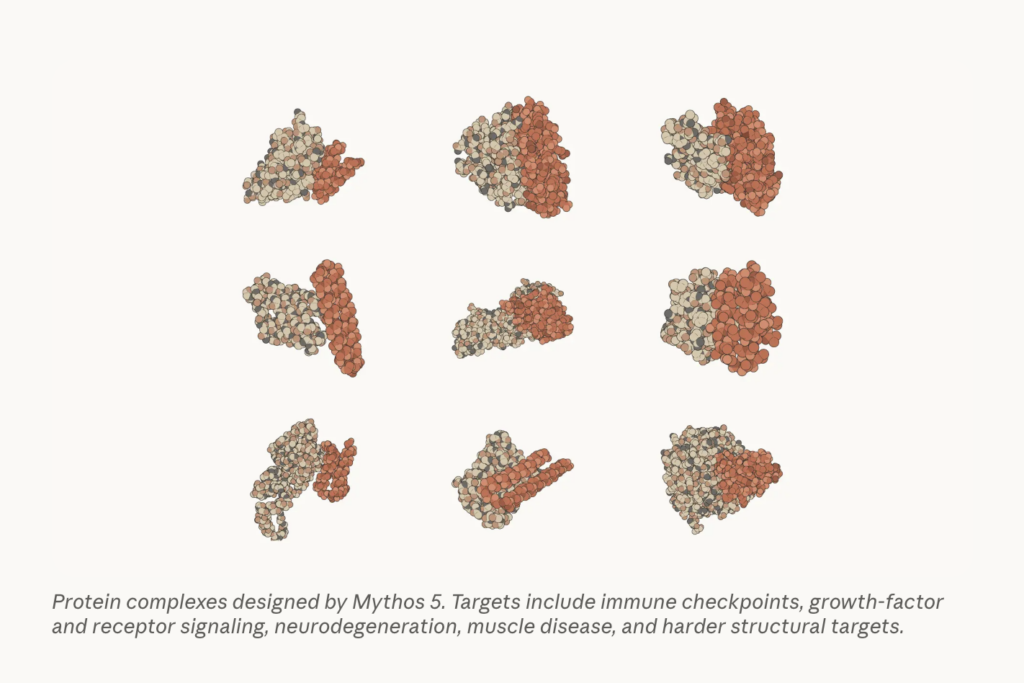
In life sciences, Mythos 5 accelerated aspects of the drug design process around ten times, with the model matching or beating skilled human operators on 9 of 14 protein targets studied, using protein design and bioinformatics tools but no human assistance.
The internet’s first question was not only “is it good?”
Early reactions around Fable 5 have not been only about capability.
Yes, the model is being discussed as a major jump for coding and long-running tasks. Cursor said Fable 5 set a new state of the art on CursorBench. Developers and AI users are also paying attention to its long-context and agentic workflow claims.
But the other half of the reaction is about pricing, access, and limits.
Anthropic is pricing both Fable 5 and Mythos 5 at $10 per million input tokens and $50 per million output tokens. That is expensive compared with many day-to-day AI workflows, even if Anthropic argues that the model may complete harder tasks in fewer turns.
There is also a temporary-access issue for Claude subscribers. Anthropic says Fable 5 is included on Pro, Max, Team, and seat-based Enterprise plans through June 22, 2026. From June 23, users will need usage credits unless Anthropic extends the included window because of capacity.
That makes the launch feel slightly unusual. Fable 5 is public, but not permanently included for many subscribers. It is broadly available, but not without cost pressure. It is the model many users will want to try, but not necessarily the model they will use casually every day.
This is why the pricing conversation matters.
Fable 5 may be the strongest Claude model for difficult work, but it also pushes users toward a more intentional question: is this task important enough for the premium model?
A safer model can still frustrate safe users
Anthropic’s safeguards are designed to reduce misuse. But broad safeguards can also catch harmless work.
Claude’s help page says legitimate security testing and benign biology research may be blocked. It also lists examples like biotech business documentation, medical imaging, diagnostics, clinical healthcare questions, and basic educational biology content as areas that may be affected if the safeguard system detects sensitive material.
That is a product problem, not just a safety detail.
If a researcher, analyst, student, developer, or business user keeps getting moved from Fable 5 to Opus 4.8, they may not experience Fable 5 as Anthropic’s best model. They may experience it as a model that is powerful but unpredictable.
For AI companies, this creates a new kind of challenge. It is not enough for the model to be capable. The boundary around the model also has to feel understandable.
Users need to know why a request was blocked, what changed, whether they are being billed differently, and whether they should rewrite the prompt or use another model. Anthropic has already started documenting this, but the user experience will matter as much as the safety architecture.
Developers will need to design for refusals and fallbacks
For developers, Fable 5 is not just a model swap.
Anthropic’s Claude API migration guide says Fable 5 is generally available through the Claude API, Claude Platform on AWS, Amazon Bedrock, Google Vertex AI, and Microsoft Foundry. The model ID is claude-fable-5.
But the guide also highlights changes developers need to account for. Fable 5 has always-on adaptive thinking, different pricing, safety classifier refusals, and a stop_reason: "refusal" response when a classifier declines a request.
Developers can also use fallback behavior, depending on platform support, so refused requests can be rerun on another model.
That means apps built on frontier models may need more graceful handling. A product using Fable 5 cannot simply assume every request will complete on Fable 5. It may need to explain to users why a model refused, why it switched, what it costs, and whether the answer came from the selected model or a fallback model.
This is a meaningful shift.
The model picker is becoming less like a simple dropdown and more like a policy layer.
Businesses should look beyond the benchmark chart
For businesses, the Fable 5 launch is a reminder that model selection is no longer only about intelligence.
A company choosing Fable 5 will need to look at capability, cost, fallback behavior, data retention, and domain restrictions. Anthropic says Fable 5 and Mythos 5 traffic is subject to 30-day retention for safety monitoring, though the company says this data is not used to train new Claude models.
That matters for teams working with sensitive documents, customer data, research files, legal materials, or internal workflows.
The strongest model may not always be the best default model. A cheaper or less restricted model may be better for routine work. A premium model like Fable 5 may make more sense for difficult engineering, research, analysis, or long-horizon agent tasks where the extra capability can justify the higher cost.
This is probably how more AI tools will be used going forward.
Not one model for everything. Different models for different risk levels, budgets, and trust requirements.
The bigger story: frontier AI is becoming gated
Claude Fable 5 is being launched as a public model. Claude Mythos 5 is being kept for trusted access. Some topics trigger fallback. Some subscription access ends after a short window. Some developers need to handle refusals in their API flows. Some enterprise users will need to think carefully about retention and governance.
All of this points to a larger shift.
AI companies are no longer just releasing smarter chatbots. They are releasing controlled capability systems.
The next frontier model may not be judged only by benchmark scores. It may be judged by who can access it, what it refuses, how often it falls back, what it costs per real task, and whether businesses can trust the rules around it.
Claude Fable 5 may turn out to be a major leap in coding, research, and long-running AI work. But its bigger legacy may be different.
It shows that the future of advanced AI may not be open access to the best model.
It may be access by permission.
Quick answers
What is Claude Fable 5?
Claude Fable 5 is Anthropic’s new Mythos-class model made broadly available for general use, with safeguards around sensitive areas like cybersecurity and biology.
What is Claude Mythos 5?
Claude Mythos 5 is the same underlying model as Fable 5, but with some safeguards lifted for approved users such as Project Glasswing partners.
Is Fable 5 better than Opus 4.8?
Anthropic says Fable 5 exceeds any Claude model it has previously made generally available, especially on longer and more complex tasks.
Why does Claude switch from Fable 5 to Opus 4.8?
Claude may switch models when a Fable 5 request triggers safety checks. Anthropic says this can happen for certain cyber, biology, life sciences, or reasoning-extraction topics.
Can everyone use Claude Mythos 5?
No. Mythos 5 is restricted to approved partners and trusted-access users.
How much does Claude Fable 5 cost?
Anthropic lists Fable 5 and Mythos 5 at $10 per million input tokens and $50 per million output tokens.
Is Fable 5 included in Claude subscriptions?
Anthropic says Fable 5 is included on Pro, Max, Team, and seat-based Enterprise plans through June 22, 2026. From June 23, it will require usage credits unless Anthropic extends the included window.
Official sources
Get the latest marketing news and trends
Delivered straight to your inbox.
Thank you for subscribing!
Stay tuned for the latest updates.
Google is testing a new program that could change how publishers are...
Shopify has added Meta as an AI commerce channel in Agentic Storefronts,...
Meta is giving AI a more direct role in deciding which actions...
Meta is expanding Meta AI with a new set of features designed...