










Jewellery is one of the easiest products to make look beautiful online, and one of the hardest to make genuinely interesting.
A ring catches the light. A necklace sits neatly against a carefully chosen outfit. The photographer delivers a polished set of images, the social media team adds a line about elegance or craftsmanship, and the post is ready.
There is nothing obviously wrong with any of that. The problem is that almost every jewellery brand can do it.
Spend ten minutes moving through jewellery accounts on Instagram and the repetition becomes difficult to miss. Product close-up. Collection announcement. Model shoot. Festival greeting. A Reel assembled from the same campaign photographs. Then another product close-up.
The feed may look expensive, but it rarely gives people a reason to stop, save the post, send it to someone or remember which brand published it.
That is the question we wanted to investigate: what separates attractive jewellery content from content that actually holds attention?
So, we analyzed hundreds of Instagram posts from a mix of established and growing jewellery brands, comparing each post with what normally worked for that particular account. This mattered because raw engagement would have made the exercise unfair. A smaller design-led label should not be expected to compete directly with the audience size of a national retailer.
The results challenged some familiar advice. Publishing more Reels did not create a meaningful advantage by itself. Posting more frequently did not make an account more efficient. Even carousels only became noticeably stronger when they helped the viewer solve a real styling or buying decision.
The larger lesson was much more useful than “post more video” or “be consistent”:
Strong jewellery content does not merely display the product. It helps people imagine wearing it, understand why it is different or connect it to a moment that matters.
That principle should shape the format, the creative idea and the wider social media strategy.
For readers looking for the practical answer first, these were the clearest lessons from the analysis:
Everything else in this guide builds from those ideas.
The updated cross-brand analysis covered 700+ Instagram posts from tens of eligible jewellery brands, published over a 90-day period.
Rather than comparing total likes between accounts, every post was measured against the normal performance of its own brand. A post from a large account had to outperform that account’s usual content, while a post from a smaller brand was judged against its own typical result.
This made it possible to study content efficiency without automatically declaring the largest brand the winner.
The research used publicly visible likes and comments. It did not include private metrics such as reach, saves, shares, watch time, paid distribution or sales. The findings therefore show visible engagement patterns. They should not be interpreted as proof that one content type generated more revenue.
The wider audit also examined positioning, posting frequency, content pillars, caption themes and brand-specific creative examples.
With the method clear, we can now move to what the analysis actually revealed, beginning with the question most jewellery teams face while planning their content: should they invest more in Reels or carousels?
Jewellery teams are often encouraged to make more Reels before anyone has asked whether the idea actually needs to be a video. Our analysis found little reason to treat Reels as the default format.When motion does add real value, tools that turn product images into video make it easy to create short, purposeful clips without forcing every idea into a Reel
Reels performed only 3.2% better than each account’s usual content, while carousels finished 6.9% higher. The gap between the two was too small to declare either format the winner.
Static images, however, showed a much clearer pattern. They performed 32.9% worse than usual, appeared in only 4.2% of the strongest posts and accounted for 31.4% of the weakest ones.
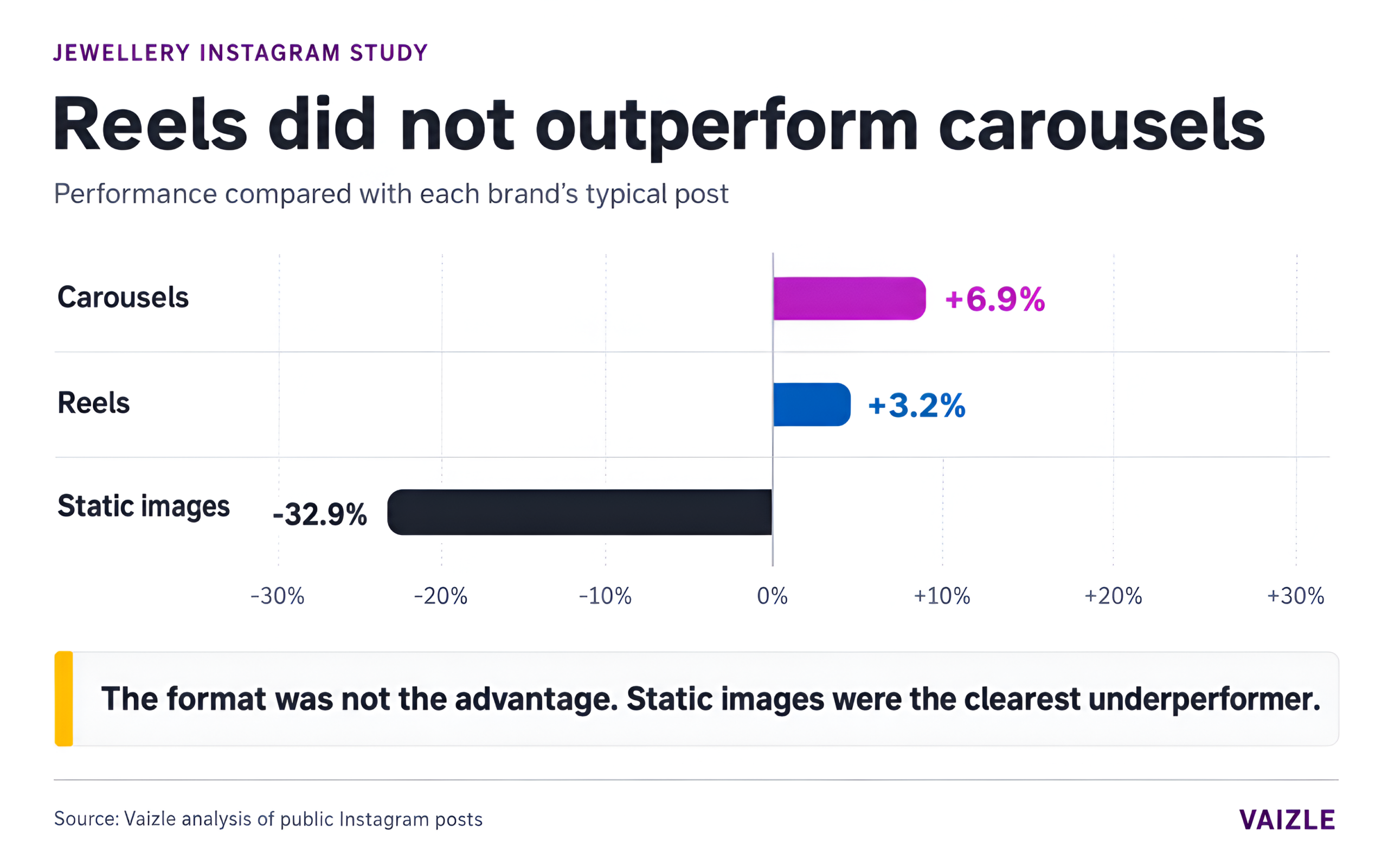
This does not mean jewellery brands should abandon photography. A distinctive campaign image, an important announcement or a genuinely striking product shot may communicate everything it needs to in one frame. The problem is the routine static post that places a product in front of the viewer without offering anything else to discover.
The same standard should apply to Reels. Video is useful when movement reveals something that a still image cannot, such as:
A rotating product set to trending audio may technically be a Reel, but it is still a product display. Jewellery brands should choose video when motion improves the idea, not because a content calendar needs another Reel.
Carousels deserve the same scrutiny. Their overall result was only modest, but one particular kind of carousel produced a much stronger outcome.
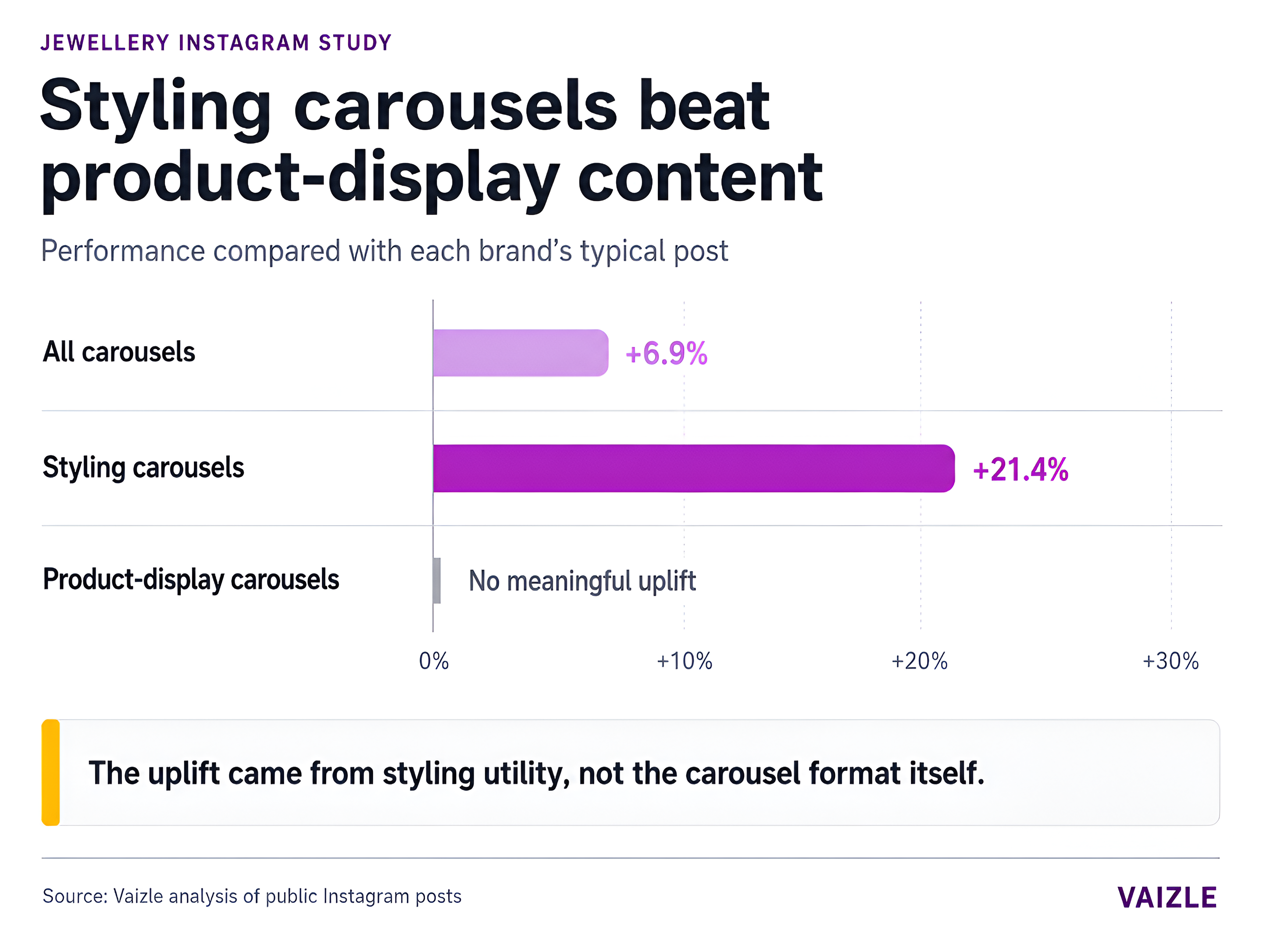
Carousels did not perform especially well simply because they contained several slides. The stronger result came from posts that helped people decide how to wear the jewellery.
Styling-led carousels performed 21.4% better than usual, considerably ahead of the 6.9% uplift recorded by carousels overall. Product-display carousels, by comparison, produced no meaningful advantage.
That is an important distinction for jewellery brands. Dividing a campaign shoot across six slides may create a carousel, but the customer is still looking at a catalogue. The extra frames become valuable only when they add context, comparison or guidance.
The styling carousels that fit this opportunity include:
This kind of content takes the customer beyond admiration and closer to a decision. Instead of asking her to look at a piece, it helps her picture where it belongs in her wardrobe and how often she might actually wear it.
The practical lesson is not simply to publish more carousels. Jewellery brands should use them to solve a styling question, compare genuinely different choices or show the product across distinct situations. When every slide is another angle of the same item, the post may contain more images without containing more value.
Styling content answers one customer question: “How would I wear this?” The next finding deals with another: “What makes this piece different from everything else I have already seen?”
Jewellery brands frequently talk about quality, although much of the language has become difficult to distinguish. Premium materials, timeless design and fine craftsmanship appear so often that the words can pass by without leaving much behind.
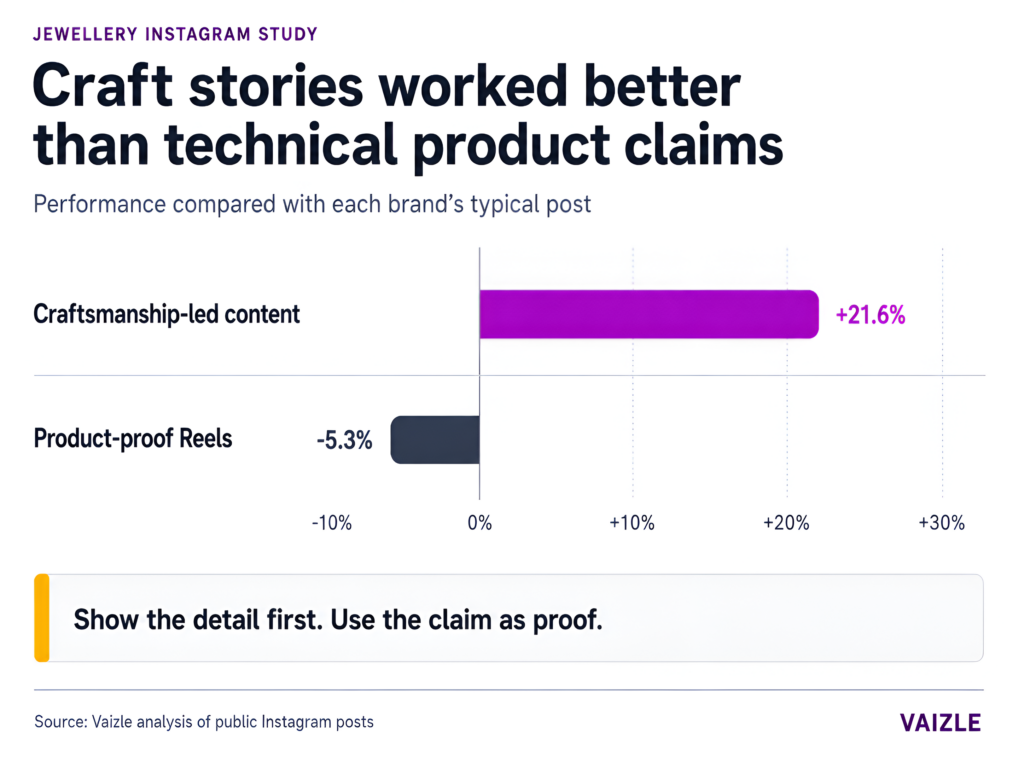
Our analysis found stronger engagement when craftsmanship became the subject of the content rather than a decorative phrase in the caption. Craft-led posts performed 21.6% better than usual.
Here, craftsmanship-led content refers to posts that focused on the making, handwork, material, technique or design thinking behind a piece. The content gave people access to something they would not normally notice from the finished product alone.
That could involve explaining:
A contrasting result made the finding more useful. Reels built mainly around literal product proof finished 5.3% below usual performance. Turning a quality claim into a video did not automatically make it persuasive.
The difference lies in how the information is introduced. “Made using premium-quality materials” asks the audience to accept a claim. Showing an unusual detail, explaining how it was created and connecting it to the finished piece gives people something concrete to understand.
A stronger creative sequence would be:
Craft can earn attention because it reveals something hidden. Product proof becomes more persuasive once the audience understands why that detail matters.
Festival content is an obvious part of jewellery marketing, which is also why so much of it looks interchangeable. Products change, colours change and the name of the festival changes, but the creative idea often remains the same.
In our analysis, specific cultural or regional content performed better than generic festival communication, recording 1.08 times usual engagement compared with 0.93 for generic festival posts.
The difference was not large enough to treat this as a universal category rule, but it is a useful directional signal. Content built around a recognisable cultural detail appeared more valuable than posts that used the festival mainly as decoration.
Generic festival content usually begins with the calendar:
The festival is approaching, so we need a festival post.
More specific content begins with what people actually experience during that occasion:
The festival itself is not always the story. The interesting material is often found in how people dress, gift, remember and relate to one another during it.
For jewellery brands, that means replacing broad lines such as “Celebrate in style” with a more precise observation about the occasion. Cultural specificity makes the content feel considered rather than scheduled.
The brands in the study followed very different publishing models. Some posted several times a day during active campaigns, while others maintained a steadier weekly rhythm or published around larger editorial moments.
Despite those differences, higher posting frequency did not produce stronger engagement efficiency. The relationship was slightly negative, with a correlation of -0.30. Accounts publishing a greater share of Reels showed the same weak negative relationship.
This does not mean posting frequently causes weaker performance. It means the analysis found no evidence that volume, by itself, improved the result of an average post.
That distinction matters because posting frequency is often borrowed from competitors without considering what supports it. A high-volume jewellery brand may have multiple product launches, store updates, creators, paid campaigns and a production team capable of generating several distinct executions from one campaign.
A smaller brand may have a handful of shoot days and one person managing the entire calendar. Matching the larger account’s output can lead to more repetition rather than more useful content.
Before adding another post, it is worth asking whether it contributes something new:
A strong campaign may support several posts because each one approaches the idea differently. Publishing the same product with a new crop, caption or trending sound is activity, but it is not necessarily a stronger content system.
It is normal for a small number of social posts to perform exceptionally well. What stood out in this study was how dramatically that dependence varied between accounts.
The top 10% of posts generated a median 41.6% of visible engagement, but the concentration ranged from approximately 29% for some brands to almost 80% for others.
That spread reveals two very different situations.
One account may produce a steady stream of posts that regularly meet or exceed its typical performance. Another may appear successful because one campaign, celebrity post or festival Reel generated a large spike while the rest of the feed remained ordinary.
Average engagement can make those accounts look more similar than they really are.
For jewellery brands reviewing their own performance or studying competitors, the biggest post of the month should not be the only reference point. A more useful review asks:
The goal is not to eliminate breakout posts. Every brand wants them. The goal is to build a system that can perform reasonably well between those spikes.
A feed supported by several repeatable content formats is more useful than one waiting for the next exceptional hit.
Timing was not the biggest driver in the study, but one pattern was strong enough to deserve testing.
Monday posts performed 15.7% better than usual, while Sunday posts finished 15.2% below.
This does not prove that jewellery audiences universally prefer Mondays. Brands may have scheduled their strongest launches, campaign films or styling content at the beginning of the week and used Sunday for lower-priority posts. The result may therefore reflect both timing and the quality of the content being published.
Still, Monday offers a sensible testing window. Rather than moving the entire calendar immediately, jewellery brands can place one of their highest-value posts on Monday and compare it with a similarly important post published on another day.
The test should look beyond likes and consider:
Timing can help a strong piece of content travel further, but it will not repair a weak creative premise. The day should be treated as a distribution decision after the idea has been developed, not as the strategy itself.
Taken together, these findings point in the same direction. Jewellery brands did not gain much simply by increasing their Reel share, publishing more frequently or turning every campaign shoot into several posts. The clearer advantages came from giving the content a useful role: helping someone style a piece, understand its craft, connect it to a real occasion or make a more confident choice.
A jewellery brand needs more than a sequence of product launches. Its content should help people discover the brand, imagine wearing the product, trust what they are buying and eventually make a decision.
A useful starting strategy can be built around five content areas.
Styling should take up the largest share of the calendar because it moves the product out of the display case and into the customer’s life.
This includes content around:
The purpose is not simply to show that a piece is versatile. It is to help someone picture when she would reach for it, what she would wear it with and whether it fits the way she already dresses.
Styling carousels are particularly useful here, although try-on Reels can work well when scale, movement or fit needs to be shown.
Product content still matters. The audit does not suggest that jewellery brands should stop showing their collections or creating beautiful campaign work.
The problem begins when every post performs the same role.
Use product and editorial content for:
A static image is perfectly appropriate when one frame can carry the full idea. If the customer needs styling context, comparison or explanation, the concept should move into a carousel or Reel.
Jewellery is not always an impulse purchase. Customers may be thinking about material quality, authenticity, comfort, durability, care, exchange policies or long-term value.
Trust content should answer those concerns with something specific.
Possible subjects include:
The aim is not to keep repeating that the product is handcrafted. Each post should reveal a different reason the craftsmanship matters.
Jewellery becomes more meaningful when it is connected with a person, relationship or milestone.
This content can explore:
Not every post needs to become an emotional film. A styling edit, gifting guide or customer story can communicate the same territory in a lighter way.
Conversion content should help someone act after interest has already been created.
That may include:
A CTA works best when it completes the post. It should not be expected to create the interest that the creative itself failed to build.
A practical starting mix would look like this:
| Content area | Suggested share |
|---|---|
| Styling and use cases | 35% |
| Product and editorial | 25% |
| Craftsmanship and trust | 20% |
| Occasions and relationships | 15% |
| Customer and conversion | 5% |
This is not a universal formula. A bridal jewellery house, an everyday silver brand and an experimental designer label will naturally need different proportions. The value of the framework is that it prevents the entire feed from becoming a stream of product announcements.
A useful content idea should begin with a customer question, not with a format.
The ideas below can be adapted for Instagram, Facebook, Pinterest, short-form video or email, depending on where the brand is most active.
| Content idea | Best format | Opening direction | Main purpose |
|---|---|---|---|
| One piece for three occasions | Carousel | “One pair of earrings. Three plans.” | Styling |
| Jewellery for different necklines | Carousel | “The neckline changes everything.” | Product choice |
| Work-to-dinner transition | Reel | Begin with the outfit change | Styling |
| Minimal versus statement | Carousel | “Same outfit. A completely different mood.” | Comparison |
| How to layer chains | Carousel | “How to layer without looking overdone.” | Education |
| Wedding guest jewellery edit | Carousel | Organise by ceremony or time of day | Occasion |
| Jewellery for a plain saree | Reel or carousel | Show the outfit before and after | Styling |
| Six details people miss | Carousel | “Look a little closer.” | Craft |
| Why this stone was selected | Reel | Begin with the unusual detail | Proof |
| Sketch to finished piece | Reel | Show the process before the reveal | Craft |
| How to care for everyday jewellery | Carousel | “The care mistake most people make.” | Trust |
| A guide to chain lengths | Carousel | Compare lengths on the body | Product choice |
| First salary jewellery story | Reel | Begin with the milestone | Emotion |
| A gift for someone difficult to buy for | Reel | Start with the relationship problem | Gifting |
| Modern regional styling | Reel or carousel | “A tradition, worn differently.” | Culture |
| Jewellery under a set budget | Carousel | “What we would choose under…” | Conversion |
| Help me choose between three | Story or carousel | Give each option a clear use case | Community |
| What makes this piece comfortable | Reel or carousel | Start with the wearer problem | Trust |
| Why this became our most-worn piece | Creator Reel | Lead with real-life use | Social proof |
| A customer’s milestone purchase | Reel or carousel | Tell the story behind the choice | Customer proof |
The wording can change, but the underlying idea should remain clear. Each post needs to help someone style, compare, understand, trust or choose the product.
Once the purpose of the post is clear, the format becomes easier to choose.
Reels work well for:
A Reel is less useful when it simply turns campaign photographs into a slideshow. Motion should reveal something, not merely satisfy a format quota.
Carousels are better suited to:
Each slide should add information or move the customer closer to a decision. When every slide performs the same job, the carousel quickly becomes repetitive.
Static posts remain useful for:
The format becomes weak only when it is used automatically for every new product.
Stories are well suited to:
They give the brand room to communicate frequently without turning every update into a permanent feed post.
A growing jewellery brand can begin with four strong feed posts per week.
That is frequent enough to create a recognisable rhythm without forcing the team to produce filler every day. It also creates room for several different content jobs rather than allowing one format or message to dominate the week.
A practical weekly structure could be:
| Day | Content focus | Suggested format |
|---|---|---|
| Monday | Occasion, identity or relationship | Reel |
| Wednesday | Craftsmanship or product trust | Reel or carousel |
| Friday | Styling and consideration | Carousel |
| Weekend | Customer, gifting or conversion support | Reel, Story or static post |
Stories can carry lighter updates between these posts, including polls, store activity, customer content and reminders.
The schedule should not become rigid. A brand launching a collection or entering a major festive period may publish more frequently. The important question is whether each additional post introduces a fresh idea, audience situation or reason to care.
The audit found no reliable engagement advantage from increasing posting volume alone, so a smaller team should not feel pressured to imitate a brand publishing several times a day.
The following plan translates the strategy into a month of content. Product details, cultural references and claims should be adapted to the brand rather than copied without context.
| Week | Day | Content idea | Format | Suggested opening |
|---|---|---|---|---|
| 1 | Monday | Identity-led discovery | Reel | “The promotion was hers. The sparkle should be too.” |
| 1 | Wednesday | Product detail or proof | Reel | “What makes this piece worth wearing on repeat?” |
| 1 | Friday | One piece, three occasions | Carousel | “One pair of earrings. Three plans.” |
| 1 | Weekend | Self-gifting | Creator Reel | “You do not need an occasion for this one.” |
| 2 | Monday | Relationship story | Reel | “For the friend who has seen every version of you.” |
| 2 | Wednesday | Craft details | Carousel | “Six details you may miss at first glance.” |
| 2 | Friday | Wardrobe problem-solving | Carousel | “Jewellery for the days your outfit needs one good decision.” |
| 2 | Weekend | Customer milestone | Reel or static | “Why she chose this for her first milestone purchase.” |
| 3 | Monday | Cultural or regional occasion | Reel | “Not just a festival look. A look that feels like home.” |
| 3 | Wednesday | Signature product truth | Reel | “The one detail we refuse to compromise on.” |
| 3 | Friday | Layering education | Carousel | “How to layer without looking overdone.” |
| 3 | Weekend | Gifting help | Reel | “For the person who is impossible to buy for.” |
| 4 | Monday | Founder or design point of view | Reel | “We designed this for people who never dress the same way twice.” |
| 4 | Wednesday | Care, comfort or longevity | Carousel | “How to make everyday jewellery last longer.” |
| 4 | Friday | Hero-product edit | Carousel | “Meet the pieces that do most of the work.” |
| 4 | Weekend | Conversion support | Reel | “Four reasons this became our most-worn piece.” |
This calendar contains several repeatable formats. A brand does not need to invent an entirely new structure every month. It can repeat the format while changing the product, occasion or customer problem.
For example, “one piece, three occasions” can become a monthly series. The same is true for craft details, gifting recommendations or customer milestone stories.
The simplest way to avoid catalogue-style content is to begin somewhere other than the product.
Start with the customer’s outfit, occasion, question, doubt or relationship. The jewellery can then enter the post as part of the answer.
Instead of:
Introducing our latest necklace collection.
Try:
Three necklaces for the outfits you wear most often.
Instead of:
Crafted with premium materials.
Try:
The small design detail that makes this easier to wear all day.
Instead of:
Celebrate the festive season in style.
Try:
Jewellery for the first festival you are hosting at home.
The product remains central, but it is no longer expected to carry the entire idea by itself.
Four rules help keep the content focused.
Avoid combining a collection launch, festival message, material claim, styling guide and discount inside the same post. The audience should be able to understand the purpose quickly.
The situation might involve getting dressed for work, choosing a wedding gift, comparing two products or wondering whether a piece is comfortable enough for everyday wear.
Show where the product fits and what it changes. This is more useful than simply announcing that the product is available.
A comment-for-link or shop-now prompt is more natural once the customer has been given a reason to want the product.
Likes are useful, but they should not become the only measure of success.
A styling guide and a discovery Reel are doing different kinds of work. Their measurement should reflect that.
| Content job | Primary metric | Supporting metric |
|---|---|---|
| Discovery Reel | Reach or plays | Shares and profile visits |
| Styling carousel | Saves | Completion and shares |
| Craft or trust content | Saves and questions | Product-page visits |
| Gifting or customer content | DMs and comments | Link clicks |
| Conversion support | Product actions | Store visits and enquiries |
At the end of each month, review the content as a system rather than celebrating only the largest post.
Ask:
It is also useful to compare posts with the account’s own normal performance. A large number of likes may still represent a weak result for a large account, while a smaller total can be exceptional for a niche brand.
The aim is to identify repeatable structures, not wait indefinitely for the next viral post.
The same content principles apply on Facebook, although the presentation may need to change.
Facebook can be particularly useful for:
An Instagram carousel may become a Facebook album or collection post. A short Reel can still be used, but the platform also gives brands more room for longer captions, direct links and community interaction.
The underlying rule remains the same: do not treat Facebook as a place to automatically repost everything from Instagram. Adapt the content to the behaviour and information needs of the audience there.
Competitor research becomes useful when it produces decisions, not a folder of screenshots.
A practical process looks like this:
For example, copying a successful wedding carousel would be superficial. Understanding that customers need help choosing jewellery for different ceremonies gives the brand a principle it can use in its own way.
This study was created using Vaizle AI’s competitor analysis feature. Vaizle lets you add public Instagram or Facebook profiles and compare their posting patterns, formats, themes and visible engagement together.
Instead of manually checking hundreds of posts, you can ask questions such as:
The useful question is not simply which competitor receives the most likes. It is what they are doing repeatedly that performs better than normal, and what they are still leaving open for your brand.
Create content around customer decisions rather than only product launches. Show people how to style the jewellery, explain details that make it different, build stories around specific occasions and introduce conversion prompts after the post has created interest.
A balanced strategy should include styling, product storytelling, craftsmanship, trust, customer stories, occasion-led content and conversion support. Avoid filling the entire feed with isolated product images.
Neither format wins automatically. Reels produced only a small uplift in our study, while styling-led carousels performed considerably better. Use Reels when movement adds useful information, and carousels when the customer needs comparison, progression or detail.
Four strong feed posts per week is a sensible starting point for a growing brand. Increase the frequency only when the team has enough creative variety to maintain quality.
Help people make a decision. Show how the product can be worn, what it pairs with, why a detail matters or which occasion it suits. Specific and useful content gives people more reason to save, share or respond.
Yes, but generic greetings are unlikely to distinguish the brand. Build the post around a real ritual, relationship, regional styling practice or gifting situation.
Useful ideas include one piece styled for three occasions, jewellery guides by neckline, layering tutorials, craft-process stories, gifting edits, customer milestones, care guides and regional styling content.
A smaller brand does not need to compete on raw reach or production budget. It can own a specific customer need that larger brands are not addressing clearly, such as workwear jewellery, affordable milestone gifting, modern regional styling or a distinctive design truth.

Purva is part of the content team at Vaizle, where she focuses on delivering insightful and engaging content. When not chronically online, you will find her taking long walks, adding another book to her TBR list, or watching rom-coms.
Connect your marketing channels, ask questions, compare performance, and get reports without jumping between dashboards.
Copyright @VAIZLE 2026
