







You post something you actually put effort into. The reach is terrible. Then three days later, a throwaway Reel you filmed in ten minutes gets 40,000 views from people who don’t even follow you.
That’s not random. That’s Instagram’s latest algorithm doing exactly what it’s designed to do. The problem is most people are trying to please one algorithm when Instagram is actually running several of them, each with completely different rules.
This blog breaks all of it down about Instagram algorithms in 2026. What each surface looks for, what actually changed in 2026, which signals move the needle, and what quietly kills your reach without you realising it.
So, let’s dive right in!
Quick answer (if you’re in a hurry)
The Instagram algorithm is a set of rules that decides which posts show up in your feed, the Explore page (FYP), and Reels. It determines the visibility of content based on different factors like relevance, engagement, timeliness, and more.
Most people simply assume Instagram has a selected number of algorithms at work. But the actual number is much higher. Instagram’s own engineering team confirmed in that the platform runs over 1,000 machine learning models across its ranked surfaces in their Journey to 1000 models post.
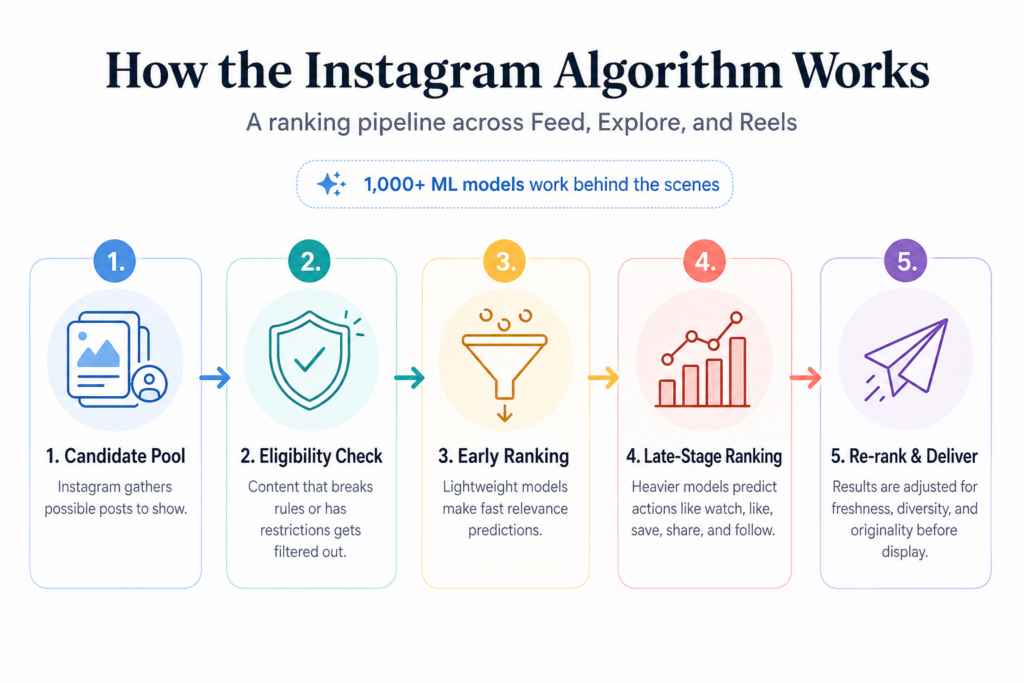
These models work in a pipeline. When you open any surface on Instagram, the system runs through roughly the same stages:
First, it pulls a candidate pool from available inventory. For Reels this is a massive pool of videos across the entire platform. For Feed it is a smaller pool from accounts you follow plus recommended content.
Then it filters for eligibility. Content that violates community guidelines, carries recommendation limits, or comes from restricted accounts gets removed here. This happens before any ranking. It is a hard gate.
Then it runs early-stage ranking using lightweight models that make quick relevance predictions. The pool gets smaller.
Then it runs late-stage ranking using heavier models, including multi-task multi-label (MTML) rankers, that predict a range of outcomes simultaneously: will this person watch it, like it, save it, share it, follow the account?
Then it re-ranks the results for freshness, diversity, and originality before delivering the final feed.
This is why the same content performs completely differently across Reels, Feed, and Explore. Each surface runs a different version of this pipeline with different objective weights.
The five main surfaces each have their own ranking logic:
On top of all this, there are two fundamental distribution tracks that apply across all surfaces:
Understanding which track you’re optimising for changes your entire strategy.
Instagram made more confirmed changes between late 2024 and April 2026 than in the two years before that combined. Some of these are new features. Some are shifts in how existing signals are weighted. All of them change how content gets distributed and to whom.
Instagram started favouring original creators over aggregator accounts in April 2024. By 2026, that preference became enforcement. Mosseri confirmed in February 2026 that accounts which primarily repost content from other accounts face reduced recommendation eligibility. Watermarked TikTok content, visible CapCut branding, and reposts of Reels that already circulated on other accounts all receive lower reach in recommendations.
The numbers show how serious this push is. 75% of recommendations in the US now come from original posts, up 10 percentage points from Q4 2025 alone. This is not a minor tweak. Instagram is actively restructuring what content its recommendation engine surfaces.
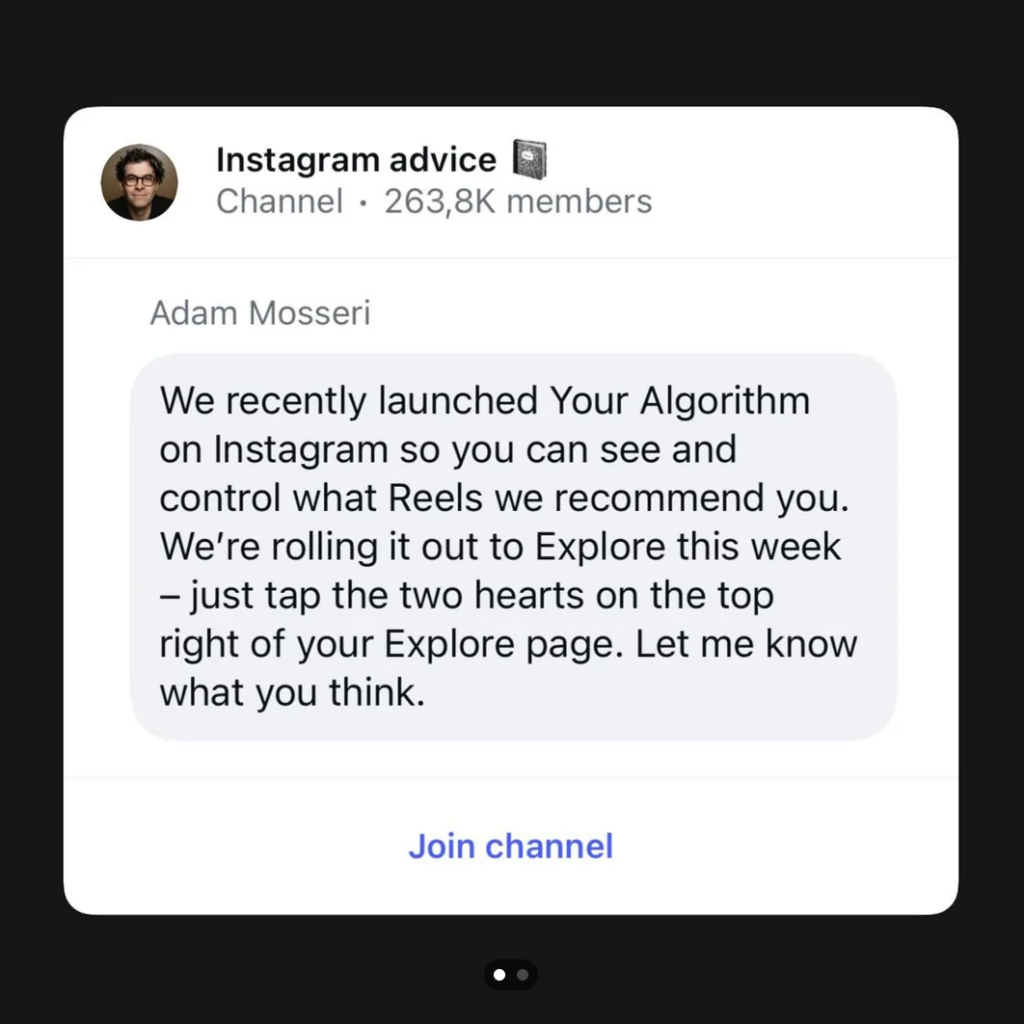
The “Your Algorithm” dashboard rolled out in December 2025 and is now live globally. Every user can go to Settings, then Content Preferences, and see the topic categories Instagram has assigned to them. They can add topics they want more of and remove ones they do not.
For creators, this changes what it means to reach your audience. A follower who has set “home workouts” as an active interest will see more content that Instagram categorises under that topic. If your fitness content is generic and does not map cleanly to a recognised topic cluster, it will not surface in those curated feeds even if that person follows you. Vague content now has a specific mechanism for underperforming.
Users can also share their “Your Algorithm” settings as a Story, which is a small but interesting social signal. People who care about their feed curation are now visible to the accounts they follow.
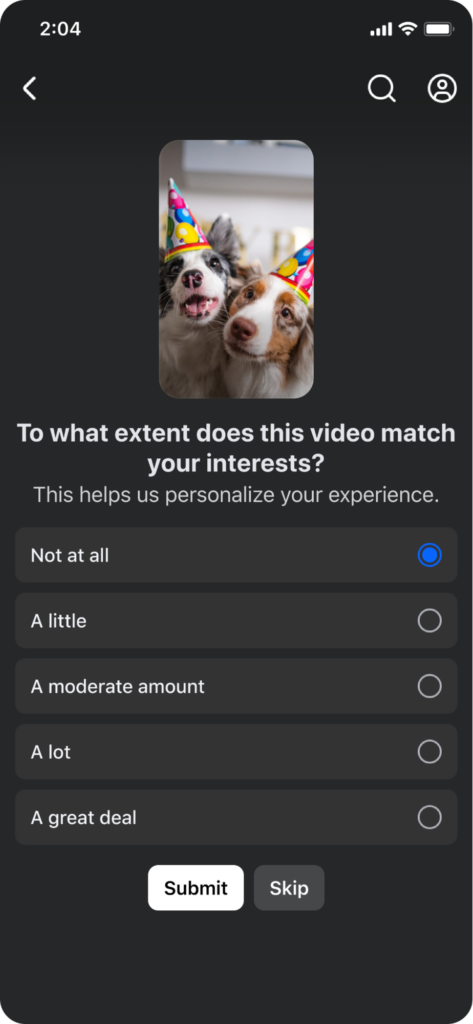
This is one of the less-covered 2026 changes and one of the more consequential ones. Instagram confirmed in January 2026 that recommendation quality is now partly measured through direct survey signals. After watching certain Reels, users get asked whether the video matched their actual interests, not just whether they watched it.
A video can have strong watch time and still score poorly on these surveys. The algorithm weighs both. This matters because it closes a gap that existed before: content that was visually engaging but ultimately not what the person wanted to see could game watch-time metrics. That is now harder to do. Instagram is trying to measure genuine interest, not just attention.
DM shares replaced likes as the primary distribution signal
This shift happened across 2025 and hardened in 2026. When Mosseri confirmed the three top signals in January 2025, sends (DM shares) were already named alongside watch time and like rate. By 2026, creator data consistently shows sends carrying the most weight for reaching non-followers.
The reason Instagram weighted this so heavily is that DM shares correlate more strongly with genuine interest than public likes do. Someone tapping “like” on a post takes one second and costs nothing. Someone deliberately sending that post to a specific person in their contacts is making an active decision about value. Instagram’s internal data showed DM shares correlate with purchase intent 4x more strongly than likes. That is why the algorithm is built around it now.
In practical terms: a post with 100 likes and 20 DM shares will outperform a post with 1,000 likes and zero shares in recommendation distribution.
Trial Reels and Early Access Reels moved from beta to standard
Trial Reels, which publishes a Reel only to non-followers first, is now a standard posting option available to all accounts. It lets you test whether a hook and topic work with cold audiences before the Reel touches your existing followers or your account’s engagement metrics.
Early Access Reels is the complement to this. It shows a Reel to your existing followers 24 hours before it goes public. Concentrated early engagement from your most loyal followers creates a stronger quality signal for the algorithm when the Reel opens to broader distribution.
Both features reflect Instagram’s acknowledgment that the test-and-learn cycle matters, and that creators should not have to risk their account-level metrics to experiment.
Reels up to 3 minutes are now eligible for full recommendations
Previously, anything over 60 seconds received reduced recommendation support. That cap is gone. Reels up to 3 minutes can now reach non-followers through Explore and the Reels feed.
The important caveat: length eligibility is not the same as length advantage. A 3-minute Reel with 40% retention will underperform a 45-second Reel with 85% retention. The change simply means longer content is no longer penalised by default. Whether it performs depends entirely on whether people actually watch it.
Your interactions with Meta AI now influence your Instagram feed
Since December 2025, how users interact with Meta AI features across Meta’s apps has been factoring into both content recommendations and ad personalisation on Instagram. If someone has been using Meta AI to research a specific topic, that signal can now shape what Instagram recommends to them.
For creators, this is a cross-platform signal that most are unaware of. It also means Instagram’s recommendation system is pulling from a broader behavioural dataset than just in-app interactions.
Hashtag following was removed in December 2024
Users can no longer follow hashtags, and hashtags they were previously following stopped appearing in feeds. This formalised what had already been happening in practice: hashtags are now a content categorisation signal, not a distribution channel. They tell the algorithm what your content is about so it can match it to the right interest clusters. They do not push your content to a hashtag feed that people browse.
Reels translations rolled out for four languages
Instagram rolled out AI-powered translations for Reels audio and on-screen text in late 2025, currently covering Hindi, Portuguese, English, and Spanish. Mosseri specifically called this out as a reach tactic since content understandable by more people earns more engagement signals. For creators posting in English, translated Reels can now surface to Hindi and Portuguese-speaking audiences who would not have engaged before.
Relationship-based ranking got heavier in March 2026
Instagram increased the weight given to accounts that users interact with frequently through DMs, comments, and Story replies. Accounts you have genuine two-way conversations with appear more consistently in your Feed and at the front of your Stories tray. For creators, this makes building actual conversations in comments and DMs a direct algorithmic advantage, not just a community-building nicety.
Instagram posts are now indexed by Google
Since late 2025, Google has been indexing Instagram post URLs with more consistency. Caption text is scraped and included in Google’s search index. Your Instagram captions can now appear in Google Search results, and they can be pulled into Google AI Overviews and Perplexity answers when someone searches a topic your caption covers.
This one change is significant enough to affect how captions should be written. Specific language, real information, and clear topic focus in captions now drive discoverability from entirely outside Instagram.
Adam Mosseri confirmed and has repeated consistently: the three most important ranking signals across all surfaces are average watch time, like rate, and send rate. These are the metrics to track, not total views or follower counts.
The longer people watch, the stronger the signal. For Reels, the first 3 seconds are a hard threshold. Instagram tracks whether viewers cross it. A Reel that loses most of its audience before 3 seconds gets throttled almost immediately.
Watch time is the most powerful signal for unconnected distribution. It is the evidence that content is worth showing to people who have never heard of the account.
This is not total likes. It is likes divided by reach. A post seen by 500 people with 50 likes has a 10% like rate. A post seen by 50,000 people with 500 likes has a 1% like rate. Instagram’s ranking treats the first as a stronger signal, even though the total like count is lower.
Like rate matters slightly more for content distributed to existing followers than for recommendation surfaces.
When someone sends a Reel to a friend in DMs, they are making a deliberate decision that this content is worth another person’s time. According to Metricool data, 694,000 Instagram Reels are sent via DM every minute. The volume is enormous, and the algorithm is built around it.
Send rate is the strongest signal for unconnected distribution. It primarily determines whether a Reel scales beyond its initial test batch.
Before publishing anything, ask: would someone send this to a specific person in their contacts? If not, that is useful information about whether the content will grow.
Below the top three, Instagram also measures:
Total follower count has no direct effect on reach. Neither does posting frequency alone. An account posting once a week with strong send rates will outperform one posting daily with weak signals.
Feed blends content from accounts you follow and recommended accounts. The split is now more than 70% recommended.
When you publish a post, Instagram assembles a candidate pool of roughly 500 posts per user per session and runs it through the ranking pipeline. At late-stage ranking, Instagram predicts the probability of five specific interactions: the user spending a few seconds on the post, liking it, commenting on it, sharing it, and visiting your profile. Higher predicted probability means higher placement.
For posts from accounts the user follows, relationship signals add weight: how often they have interacted with this account previously, whether they view their Stories, whether they DM them.
For recommended posts, interest signals dominate and relationship signals drop away.
Carousels are the strongest format in Feed right now. A Socialinsider study of 150,000 posts found carousels generate 55% more reach and 70% more saves than single-image posts. Carousels with 7 to 10 slides outperform those with 3 to 4. Each swipe registers as an engagement signal. Instagram also re-shows carousels to users who did not finish swiping, giving the post a second distribution window.
Account-level consistency carries a recovery cost now. Instagram uses your account’s recent engagement history as a prior before distributing your next post. Two weeks of silence means less recent signal, which makes the algorithm more conservative with initial distribution. There is a real recovery window before reach returns to previous levels.
Feed limits consecutive posts from the same account within any one session. Even frequent followers will not see three of your posts in a row. Instagram deliberately diversifies the feed.
50% of all time spent on Instagram happens in Reels. The average Reels reach rate is 30.81%, compared to 13.14% for photos. 55% of Reels views come from non-followers. For reaching new audiences, Reels is the primary channel.
The Reels algorithm operates on an entertainment graph rather than a social graph. Who you follow matters much less here than what you watch, share, and replay.
When you publish a Reel, Instagram runs it through the multi-stage pipeline. Candidate retrieval pulls it into a relevant pool. Early-stage ranking makes a quick pass. Late-stage ranking uses heavier MTML models to predict watch-through rate, send rate, replay rate, and saves simultaneously. The Reel is scored against all of those at once.
Instagram then shows it to a small test batch of non-followers. If watch time and send rate clear internal thresholds, the Reel goes to a larger batch. Each expansion requires clearing those thresholds again. This is why a Reel can sit at a few hundred views for two days and then jump sharply. It cleared a threshold and the next distribution batch is larger.
Instagram’s official Reels system card names “short-watch avoidance” as an explicit ranking signal. A high rate of viewers leaving before 3 seconds is a direct distribution penalty. Your hook is a ranking factor, not just a creative decision.
Hooks do not need to be dramatic. They need to create enough immediate value or tension that the next second of watching costs the viewer nothing.
Reels up to 3 minutes are now eligible for full recommendation distribution.
For reaching non-followers: 15 to 45 seconds tends to get the highest completion rates, which drives send rate. For saves and depth: 60 to 90 seconds works when the content genuinely earns that time. For tutorials or structured content: up to 3 minutes, but only if retention stays above 50% throughout. If it drops significantly at the midpoint, a shorter version will outperform.
Publish as a Trial Reel first. After 24 hours, check non-follower watch time and send rate. If watch time is low, the hook needs work. If watch time is strong but send rate is low, the content holds attention but is not specific or shareable enough. If both are strong, convert it to a full post and the existing signal carries forward into broader distribution.
If you are confident in a Reel, use Early Access instead. This shows it to existing followers first for 24 hours before broader release. Their concentrated early engagement acts as a stronger quality signal when the Reel opens to non-followers.
Meta confirmed in January 2026 that same-day content is getting more recommendation support. A Reel tied to something happening today gets a freshness multiplier that evergreen content does not. For accounts in any niche where current events, trends, or seasons are relevant, tying content to what is happening this week has measurable value.
Explore is a pure discovery surface. Existing followers have nothing to do with what shows up here. It is entirely interest-based matching between content and users who do not yet follow the account.
The Explore pipeline runs the same multi-stage structure. Retrieval pulls candidates based on topic similarity and quality predictions. First-stage ranking does a lighter pass. Second-stage ranking uses heavier models. Final re-ranking adds diversity and freshness.
Your existing followers are the qualifying round. When a post earns strong saves and comments from people who already follow you, Instagram reads that as quality evidence and enters the post into the Explore candidate pool. Without that early follower signal, most posts never reach Explore.
Explore categorises content at a specific level now. A post about beginner strength training for women over 40 gets matched to users with that specific interest cluster, not to everyone who has ever engaged with any fitness content. A post with a precise, narrow topic focus will outperform a broadly relatable post with no clear category on Explore, even if the broad post has higher total engagement.
On Explore, your content competes visually in a grid. Users do not see captions or accounts before clicking. The first frame or cover image is the only thing determining whether someone clicks. A weak thumbnail will underperform regardless of what the video actually contains.
Stories uses the most direct relationship signals of any surface. Ranking is built around how frequently a specific person has interacted with your account directly.
What determines your position in someone’s Stories tray:
Stories is not a growth surface. It is a loyalty surface. What you are doing is maintaining relevance with existing followers, which has indirect effects on Feed distribution because Instagram uses relationship depth as a signal for connected distribution.
Accounts with active Broadcast Channels where subscribers react and reply signal a high-quality audience relationship at the account level. Instagram uses this as a trust signal that lifts Feed distribution for regular posts, not just Broadcast Channel content itself.
Interactive stickers generate direct replies, which move you up the tray for those specific users who respond. Polls, question boxes, and sliders all count.
Stories viewing order adapts quickly. If someone consistently skips your Stories, you move down their tray fast. Consistent through-views are more valuable than high posting volume.
Instagram Search has a two-part ranking system. For accounts and hashtags, text relevance comes first: how closely the query matches the username, display name, bio, and hashtags. For posts, it layers in popularity signals, topic relevance, and the searcher’s past behaviour.
What Instagram Search actually reads: usernames, display names, bios, captions, hashtags, alt text on images and Reels, and on-screen text within videos.
Your caption is a searchable document, not just context for the post.
A Reel about how to clean a cast iron pan should say those exact words in the caption. Not “kitchen tips” with a pan emoji. The algorithm reads text, not intent. A bio that says “fitness coach helping women over 35 build muscle” will surface in relevant searches. A bio that says “living my best life one rep at a time” will not surface in any search.
Instagram largely deprecated dedicated hashtag browsing feeds. Hashtags now function primarily as a topic signal that helps the algorithm categorise content for Explore and recommendation matching. Five to ten specific, niche-relevant hashtags is the effective approach. Using thirty broad hashtags dilutes your topic signal rather than expanding reach.
Instagram lets you write alt text for every image and Reel thumbnail through Advanced Settings when posting. Most accounts never use this. The algorithm reads it. It is also a genuine accessibility feature.
Since late 2025, Google has been indexing Instagram post URLs with more consistency. Caption text is scraped and included in Google’s index. Your Instagram captions can now appear in Google Search results, Google AI Overviews, and Perplexity answers when someone searches for a topic your post covers.
Writing captions with clear, specific language is no longer just good Instagram practice. A caption written like a short article on a specific topic can now drive discoverability from entirely outside Instagram.
Mosseri confirmed in February 2026 that content carrying TikTok watermarks, visible CapCut branding, or other third-party platform logos receives reduced recommendation reach. Accounts that primarily repost others’ content, even without watermarks, face reduced recommendation eligibility. Instagram’s originality detection has improved significantly through 2025 and 2026.
Instagram’s Reels system card names this explicitly. A high rate of viewers leaving before 3 seconds slows distribution almost immediately. The initial test batch will not expand if this signal is poor, regardless of how the rest of the video performs.
The first hour after posting is when Instagram gathers the initial engagement signal that determines how broadly to distribute the post. Not responding to early comments keeps the comment depth signal weak. Responding to early comments with substantive replies improves the comment quality signal during the critical early window.
Editing a Reel after it is live, particularly in the first 24 hours, can reset the engagement signal pool the algorithm has already gathered. Deleting and reposting is less risky than editing in place when a change is necessary.
Captions using “comment YES if you agree” or “drop an emoji below” are recognisable patterns to Instagram’s classifiers. Distribution for engagement bait has been reduced since 2023 and the detection has improved. Genuine questions that invite real responses are fine.
What some call a shadowban is what Instagram officially calls “recommendation limits.” Content is restricted from appearing in Explore, Reels recommendations, and non-follower hashtag results while remaining visible to existing followers. Typically caused by repeated community guideline violations or patterns of inauthentic engagement.
Check Settings, then Account, then Account Status to see if any limits are active on your account.
No outright ban. But accounts posting primarily AI-generated content with no real human element see reduced recommendation reach on Explore and in Reels. AI-assisted content with genuine human involvement, real voice, real commentary, real footage, is treated differently.
Settings, then Content Preferences, then Reset Suggested Content.
This clears your recommendation history across Explore, Reels, and Feed suggestions. Recommendations will feel generic for 24 to 48 hours while the algorithm rebuilds from your next interactions.
After resetting, spend 15 to 20 minutes engaging only with content from the niche you want. Watch Reels fully. Save posts. The algorithm rebuilds quickly when given concentrated signals.
Your Explore feed has drifted completely off topic and is not self-correcting. You have pivoted your content focus and want recommendations to reflect the new direction. You are managing a client account where the prior engagement history is completely irrelevant to the current use.
A reset changes what you see. It does not change how your content is distributed to other people. If your reach has dropped, a reset will not fix it. Those are separate systems.
Inside Content Preferences there is a section showing the topics Instagram has assigned to you. You can remove topics and add new ones. This directly shapes your recommendation feed.
The reverse matters for creators. Your followers have the same control. If a follower has “personal finance” active in their interests and your content is clearly about personal finance, you appear more in their curated feed. If your content is topically ambiguous, it will not match any active interest regardless of your follower count.
When users tap “Not Interested” on a post, Instagram removes that content style from their recommendations for a significant window. As a creator, you will not see this data directly, but a consistent “Not Interested” rate on a content type will show up as suppressed reach on that type.
Saves signal “I want to come back to this.” Sends signal “this is worth someone else’s time right now.” Send rate is the stronger distribution trigger for non-follower reach. Content that earns DM shares tends to be highly specific, immediately applicable, or the kind of thing that makes someone think of a particular person. Not broadly relatable. Specifically relatable to someone’s specific situation.
Carousels with 7 to 10 slides generate 55% more reach and 70% more saves than single-image posts on Feed. Reels generate a 30.81% average reach rate compared to 13.14% for photos. These are not marginal differences. They reflect genuinely different algorithmic weights for different formats.
Caption dwell time is a tracked signal. When someone expands and reads a long caption, that time on post counts. Accounts writing substantive captions with real opinions, specific information, or experience-based observations are seeing this rewarded. The first visible line still needs to earn the “more” tap. The content after it needs to be worth reading.
Instagram distinguishes between a comment thread where people leave single words and one where people write full sentences and reply to each other. A post with 30 substantive exchanges outperforms one with 200 fire emoji comments. Questions that require a real answer, not a reaction, produce a better comment quality signal.
Instagram has been building features that connect content: linked Reels, recurring format recognition, series structures. Accounts posting within a coherent topic cluster benefit from two things. Viewers who engage with one piece go looking for more. The algorithm builds a stronger topic association for the account over time, improving recommendation matching precision.
Coherence does not mean posting about exactly one thing. It means having a consistent point of view connecting the content. An account covering fitness, nutrition, and sleep through the lens of recovery science is coherent. An account posting fitness content, travel vlogs, and tech opinions is not, and recommendation matching suffers for it.
Meta confirmed in January 2026 that same-day and timely content is getting more recommendation support. A Reel connected to something happening right now has a freshness multiplier that evergreen content does not. For accounts in any niche where trends, current events, or seasons are relevant, tying content to what is happening this week has measurable algorithmic value.
Instagram Insights shows when your specific followers are most active. Posting 30 to 60 minutes before that peak means early engagement is building during the period most followers are online. Early engagement velocity in the first few hours shapes how broadly the algorithm distributes the post.
| Account size | Avg Reels reach rate | Avg engagement rate | Strongest format |
|---|---|---|---|
| Under 5K | 28% to 35% | ~3.79% | Reels and carousels |
| 5K to 50K | 22% to 30% | ~2.1% to 2.8% | Reels |
| 50K to 500K | 15% to 22% | ~1.2% to 1.8% | Reels and carousels |
| 500K+ | 8% to 15% | ~0.7% to 1.2% | Reels |
Smaller accounts get higher Reels reach rates proportionally. Instagram’s 2024 originality update explicitly aimed to give smaller original creators a more equal chance to break through. The discovery playing field is more level than it looks.
Declining engagement rates as accounts grow are expected and normal. A 1% engagement rate on a 500K account is 5,000 interactions per post.
Track saves separately from overall engagement. Most analytics tools blend saves into a single engagement metric. Because saves carry roughly 3x the weight of likes in the algorithm’s ranking, the save rate alone is more informative than a blended number.
The Instagram algorithm responds to how audiences behave with your content. Average watch time, like rate, and send rate. Those three numbers tracked weekly will tell you more about your Instagram performance than anything else.
To track all of this without pulling data manually, Vaizle’s free Instagram Analytics tool surfaces these metrics automatically and shows patterns across your content over time.
Average watch time, like rate, and send rate. Watch time matters most overall. Like rate matters more for reaching existing followers. Send rate matters most for scaling Reels to non-followers.
It shows the Reel to a small non-follower test batch first. If watch time and send rate clear internal thresholds, it expands to a larger batch, and the same thresholds apply at each stage. The first 3 seconds determine whether that initial test batch stays engaged enough for expansion to happen.
Yes. Send rate is one of the three confirmed top signals. Metricool data shows 694,000 Reels are sent via DM every minute. It is the clearest signal Instagram has that content is worth pushing to people who do not yet follow the account.
A dashboard inside Settings under Content Preferences that shows users which topics Instagram has assigned to their recommendations, with the option to add or remove topics. It rolled out globally in late 2025 and early 2026. Creators are affected because followers using this feature will see topic-matched content more and unfocused content less.
A feature that publishes a Reel only to non-followers first. Existing followers do not see it unless you choose to share it later. Used for testing hooks and topics without affecting your account’s engagement metrics if the Reel underperforms.
Check Account Status inside Settings first. This shows whether your account has active recommendation limits and the reason. Other common causes: sustained weak watch-time on recent posts, content earning “Not Interested” taps at a high rate, a posting gap that reduced the algorithm’s recent signal pool, or editing a Reel within its first 24 hours.
No outright ban. Accounts posting primarily AI-generated content with no real human element see reduced recommendation reach on Explore and in Reels. AI-assisted content with genuine human involvement is treated differently.
Yes, as a topic categorisation signal rather than a distribution channel. Five to ten niche-specific hashtags is the effective approach now that dedicated hashtag browsing feeds have largely been removed.
Instagram calls it “recommendation limits.” Content is removed from Explore, Reels recommendations, and non-follower hashtag results while remaining visible to existing followers. Check Account Status in Settings to see if any limits are active on your account.

Siddharth built two bootstrapped companies from the ground up: Vaizle and XOR Labs. He’s personally managed over Rs 100cr in ad budget across eCommerce, D2C, ed-tech, and health-tech segments. Apart from being a full-time marketer, he loves taking on the challenges of finance and operations. When not staring at his laptop, you’ll find him reading books or playing football on weekends.
Copyright @VAIZLE 2026
