OpenAI Announces ChatGPT Ads. Here’s What That Really Means.
OpenAI has announced ads for ChatGPT. This article breaks down why now, how ads may show up, and what it could mean for trust and advertisers.
OpenAI came up with two new announcements in past 24 hours, and suddenly ChatGPT feels less like a clever product & more like a business model. (Well, everything is a business model if it needs to survive in a capitalist society, but till now the reality of ChatGPT being a money-making machine didn’t hit that hard!)
Anyway, here are two OpenAI updates that made news:
• ChatGPT Go plan is now available worldwide. In US, it is priced at $8. (ChatGPT Go was first launched in India for country’s massive user base adoption for INR 399 only.)
• Now, the update that we all know was coming (just not how soon!). Ads are coming to ChatGPT. For now, ads will be tested across the US for free and Go tier users. Gradually, they’re coming for all of us!
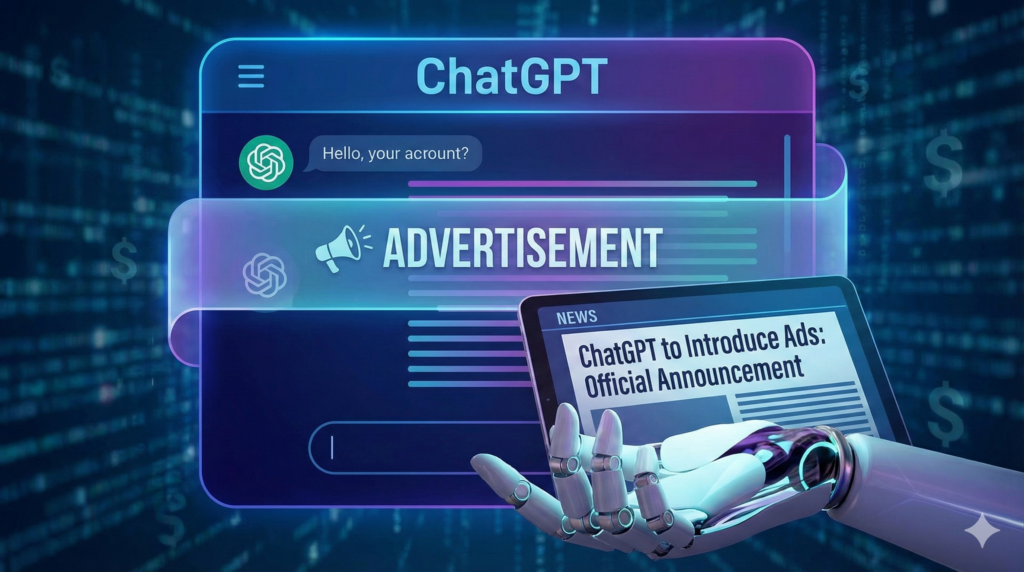
If you’ve personally spent enough time around tech and marketing, you recognize this moment. It is where an interface stops being a neutral window, and starts being a marketplace. I’m not old enough to recall the moment when Google decided to bring ads, but it must’ve been something similar.
In many ways, the story is kinda similar. Google once pledged to simply remain a search engine, but went on to show ads. Same is happening with ChatGPT.
Well, here’s what matters: For now, OpenAI is saying the right things: ads will be separate from responses, privacy stays intact, sensitive topics are off limits, you get controls. But again, for how long?
Why did ChatGPT launch ads?
Because subscriptions alone don’t satisfy the math of scale. Not when you are serving millions of people, most of them free, with a product that burns real money every time it answers.
This is also where the Sam Altman angle matters.
Altman has openly sounded allergic to ads in the past. He’s called ads a “last resort” and has framed them as something that can mess with trust. That wasn’t a random opinion. It was basically a product philosophy: make money from people who want more, not from people who simply exist.
So what changed & why did ChatGPT decide to launch ads?
1) The cost of “free” got too expensive.
Running frontier AI is not like running a normal SaaS. You cannot “just scale” without paying for compute. And OpenAI’s own reported numbers (revenue growing fast, burn still massive) keep pointing to the same reality: this is an expensive business even when you are winning.
2) Competition got serious, and it got crowded.
In 2023, ChatGPT felt like a category. In 2026, it’s a battlefield. Google has Gemini. Anthropic has Claude. Meta is pushing hard on AI distribution. Open source keeps getting better. And when users have options, you cannot keep raising prices forever without risking churn.
3) The talent war is not a tweet, it’s payroll.
Meta (and others) have been publicly linked to aggressive hiring attempts and huge offers. Whether every number is true or inflated, the direction is clear: top AI talent is being priced like elite athletes. That pressure hits costs, morale, retention, roadmap, all of it.
4) Ads are the most obvious “next lever” when you have mass usage.
If you have a massive free user base, ads are the internet’s default monetization engine. It is not even a moral choice half the time, it’s a financial reflex. Which is why OpenAI is pairing this with Go. Go expands access. Ads help subsidize that access. It’s a clean story on a slide.
5) And yes, the Google parallel is real (and slightly ominous).
Google once made very clear promises about avoiding banner ads in core experiences. Then the ad footprint evolved. Then “evolved” became “expanded.” Then it became the business.
ChatGPT may not copy Google exactly, but the gravity is similar: once ads enter the room, they slowly start influencing what the room is designed for.
OpenAI’s guardrails sound responsible today. Separation from answers. No selling your chat data to advertisers. Sensitive topics blocked. Controls for personalization. All good.
The real question is what happens six months after the first quarter where ads work too well.
Because at that point, ads won’t be an experiment. They’ll be a dependency.
How ads will show up in ChatGPT?
First, the boring but important line: there are no ads in ChatGPT right now. OpenAI says ads are not live yet, and what they have announced is a test.
Now, how will it actually look when the test starts?
OpenAI’s plan (at least for the first version) is pretty specific: ads will show up at the bottom of an answer when there’s a relevant sponsored product or service connected to what you are already talking about. Not “embedded” inside the response. Not blended into the text. The ad is supposed to sit separately, like a distinct unit that you can clearly recognize as paid.
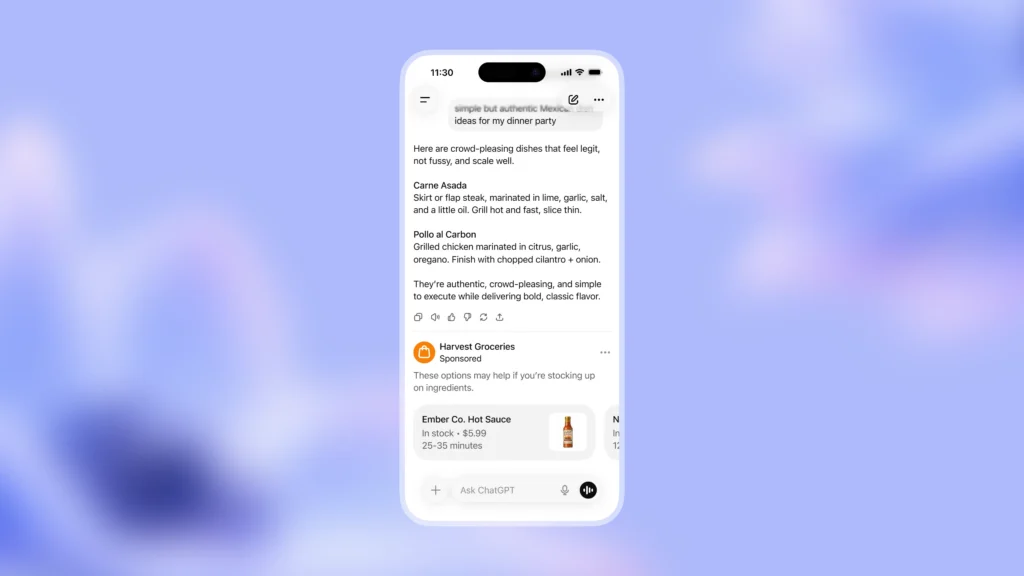
They are also leaning hard on clarity. Ads will be clearly labeled and kept separate from ChatGPT’s responses, with a promise that ads do not influence the answer you get. In other words, the model is not meant to bend its output to please an advertiser (that is the claim, and it is the central trust bet here).
What you will be able to do as a user (this part matters more than the placement):
- You can learn why you are seeing an ad (the “why this ad” style transparency).
- You can dismiss an ad and tell OpenAI why you do not want it.
- You can turn off ad personalization, and you can clear the data used for ads.
There are also hard exclusions in the announcement: OpenAI says it will not show ads to users under 18, and ads will not be eligible near sensitive or regulated topics like health, mental health, or politics.
All of this sounds “reasonable” on paper. But here’s the thing. Once ads exist, the product now has a second job: not just helping you, but also proving that the ad system works. The first format is “bottom of answers.” Fine. The more interesting question is what format comes next.
What does it mean for advertisers?
If you are an advertiser, this is not “another placement.” It’s a new kind of moment.
On Google, you bid on keywords. On Meta, you bid on people. In ChatGPT, the ad shows up inside a conversation, usually at the bottom of an answer, when there’s a relevant sponsored product or service tied to what the user is already talking about.
That changes a few things immediately.
1) This is intent, but not the keyword kind.
People don’t type “best project management tool.” They say, “I’m drowning, my team is missing deadlines, I need something simple.” That is not search. That’s context. And it’s often more honest than what people type into a search bar.
So if your product only wins when people already know what to search, you might struggle here. But if your product wins when a problem is described in plain language, this could become a very valuable surface.
2) The first winners will be the simplest offers with the clearest positioning.
Early reporting suggests this starts with shopping-style sponsored placements.
That usually rewards the most boring marketing skill that people love to ignore: clarity.
What do you do? Who is it for? Why is it better right now? If your answer is fuzzy, ChatGPT will not magically fix it. The ad unit may be small, but the user’s skepticism will be big.
3) Measurement is the question nobody has answered yet.
OpenAI has explained the principles and the placement. They haven’t really explained the advertiser side in public yet: self-serve vs managed, attribution, reporting, brand safety controls, how auctions work, what “success” is measured against.
And if you’ve run ads long enough, you know this is where the real game is. A new ad channel is exciting. A new ad channel with unclear attribution is how budgets get burned.
The bigger shift: you’re not just competing with other advertisers. You’re competing with the answer itself.
If the response solves the problem well, the ad has to be genuinely useful to earn the click. That’s good for users. It’s also a warning to lazy ads.
So the smartest advertiser move right now is not “how do I get in early.” It’s “if this becomes a habit for users, what would they want to see at the bottom of a helpful answer… and would my offer deserve to be there?”
Get the latest marketing news and trends
Delivered straight to your inbox.
Thank you for subscribing!
Stay tuned for the latest updates.
Google is testing a new program that could change how publishers are...
Shopify has added Meta as an AI commerce channel in Agentic Storefronts,...
Meta is giving AI a more direct role in deciding which actions...
Meta is expanding Meta AI with a new set of features designed...