





You find a winning ad. Two weeks of solid ROAS, stable CPA, consistent spend. Everything is working.
So you increase the ad budget.
By day 3, CPA is up 40%. By day 5, ROAS is nearly half what it was. So, you revert to the original budget. But performance doesn’t fully come back.
It’s one of the more frustrating things while working in paid media. You did everything right. You waited for results. You scaled what was working. And the reward was a broken campaign.
Here’s what actually happened. Facebook’s algorithm builds a model of who converts for your ad, at what time, on what placement, at what frequency. That model takes real spend and real conversion data to develop. When you increase budget significantly, the algorithm treats it as a new input and starts re-learning. The audience it was exploiting confidently gets replaced with broader, noisier exploration. CPAs spike. ROAS swings. And if you panic and make more changes while it’s still re-learning, you keep resetting the process.
The fix isn’t a trick. It’s knowing a few specific things before you touch the budget: whether your campaign has actually finished learning, what your break-even ROAS is (not your target, your floor), how much you can increase budget at one time without triggering a reset, and which signals tell you the campaign is saturating before performance falls off a cliff.
This guide on how to scale Facebook ads without losing ROAS covers all of it.
If you want a baseline before starting, check our Facebook ads benchmarks to see what stable, scalable performance looks like across industries.
Most people assume scaling is just a budget problem. Spend more, get more. If only.
The real issue is the learning phase. Every time you make a significant change to an ad set, including a budget increase above 20%, Facebook’s algorithm stops using what it already learned and begins testing again from scratch, causing performance to swing unpredictably while it re-explores your audience.
Think about what that actually means. You’ve been running a campaign for two weeks. The algorithm has figured out who converts for your offer, at what time, on what placement. That took real spend to develop. One budget jump wipes it. It starts over, on more money, with less certainty.
Underfunded campaigns, fragmented ad set structures, and impatient mid-flight edits are the most common reasons campaigns get stuck in “Learning Limited” status, where delivery stays inconsistent and spend gets wasted.
In such scenarios, most advertisers respond to the CPA spike by making more changes. New creative, tighter audience, adjusted bid. Each change resets the clock again. The campaign spirals while the budget burns.
This isn’t bad ad strategy. It’s bad timing. The fix is knowing exactly when to make changes, how large those changes can be, and what to watch before performance falls apart. The rest of this guide covers that, step by step.
Scaling too early is the most expensive mistake in paid media. The campaign looks good for three days, you increase budget, and two weeks later you’re wondering what happened.
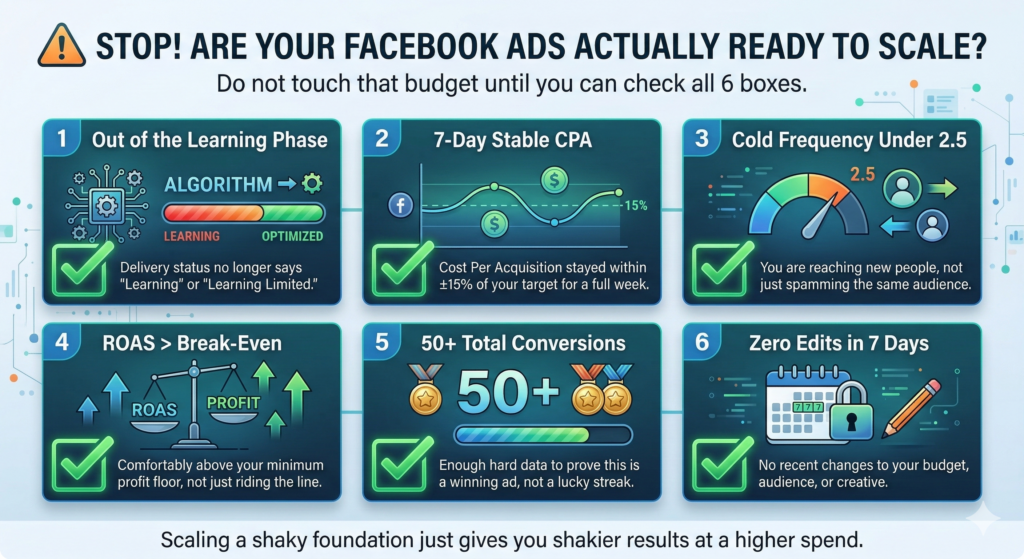
Run through this checklist before touching anything. If you can’t check all six, the campaign isn’t ready.
If you have fewer than 5 boxes checked, don’t scale your Facebook Ads just yet. More budget amplifies what’s already happening in the campaign. Shaky foundation means shakier results at higher spend.
👉 RELATED: Not sure what the learning phase or ROAS actually means? Start with our Facebook ads beginner guide first.
Most advertisers set budgets based on what they’re comfortable spending. The algorithm doesn’t care about comfort. It needs math.
Two numbers decide whether scaling is viable at all.
This is the floor. The minimum ROAS you need to not lose money.
Break-Even ROAS = 1 divided by your profit margin
40% margin means your break-even is 2.5x. 25% margin means it’s 4x. Simple, but most people have never written this number down before scaling.
The target before scaling your Facebook ads isn’t to be at break-even. It’s to be above it with room to spare. A good rule: don’t scale unless ROAS is at least 20% above your break-even. That buffer absorbs the natural performance dip that comes when you increase budget.
This is the budget required for Facebook to actually learn. Too low and your ad set sits in “Learning Limited” indefinitely, no matter how long you wait.
Minimum Daily Budget = (Target CPA x 50) divided by 7
If your cost per purchase is $30, you need around $214 per day for that ad set to realistically exit the learning phase. If your CPA is $60, that number doubles to $428.
This is why so many small-budget campaigns never stabilize. When a $50 daily budget is paired with a $40 CPA target, the campaign can only generate roughly 9 conversions per week, far short of the 50 Meta needs to optimize effectively.
Calculate both numbers before you scale anything. If the math doesn’t work at your current budget, no scaling strategy will fix it.
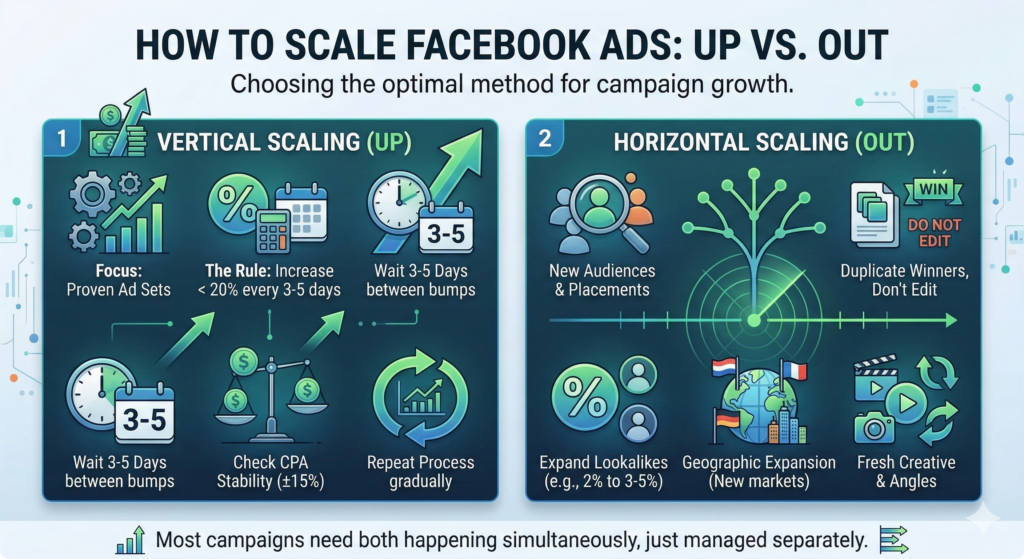
Vertical scaling means spending more on a proven ad set. It’s the most direct growth lever, and the one most commonly misused.
The rule that matters most: increase budget by no more than 20% every 3 to 5 days.
Budget increases above 20% are one of the most common triggers for a full learning phase reset, sending the algorithm back to exploration mode and causing CPA to spike while it rebuilds its optimization data.
Here’s the process that actually works:
Step 1: Increase budget by 10 to 20%. Not 50%. Not double. Set a reminder and leave it.
Step 2: Wait 3 to 5 days. Resist the urge to check it every few hours. For mid-budget campaigns spending between $100 and $300 per day, it typically takes 5 to 7 days to build enough conversion volume to make data-backed decisions after a change.
Step 3: Check CPA stability. If CPA held within ±15% of your target after day 3, the increase is working. If it spiked, don’t revert immediately. Give it the full 5 days before drawing conclusions.
Step 4: Repeat. Another 10 to 20%, another wait period. This is how you go from $50 a day to $500 without the campaign falling apart.
One alternative worth knowing: instead of editing the budget on your winning ad set, duplicate it at a higher budget and run both. The original keeps performing at the proven spend level while the duplicate begins its own learning at the new amount. Slower, but far safer.
One more thing to avoid: don’t add dayparting restrictions while scaling. Limiting delivery hours reduces conversion volume, which can push the ad set back into learning and undo the progress you’ve been carefully building.
Pro Tip: Never increase budget and change the creative in the same move. Two changes at once means two resets at once. One variable at a time, always.
Vertical scaling has a ceiling. At some point the audience saturates, and pushing more budget into the same ad set stops producing more conversions. That’s not a failure. It’s just physics. Time to scale out, not up.
Horizontal scaling means growing reach without disturbing the ad sets that are already working.
Lookalike audience expansion. If your 1% lookalike has been running for several weeks, it’s likely showing saturation signals. Duplicate the winning ad set to a 2% or 3 to 5% lookalike. You lose some precision, but you gain significantly more reach, and the audience is still pre-qualified based on resemblance to your existing buyers.
Geographic expansion. Same creative, same offer, new markets. This works particularly well for brands with broad product appeal. Start with markets that share language or buying behavior with your current top-performing geography. A brand converting well in the US often finds similar traction in Canada or Australia before expanding further.
Placement expansion. If your wins are coming from Feed, test Reels and Stories placements. They reach different scroll behaviors and different segments of your audience. Many advertisers ignore them because Feed feels familiar, which means less competition and often lower CPMs in those placements.
Creative variation. Same audience, new angles. Don’t wait for fatigue to appear before you start. When frequency rises quickly or ROAS starts to drop, the right move is to duplicate the campaign structure, reset learning with a fresh creative, and scale from a clean slate rather than continuing to push spend into a tired ad.
Horizontal scaling is how you grow without disturbing the algorithm. Vertical scaling extracts more from what’s already working. Most campaigns need both happening at the same time, just managed separately.
This debate comes up in almost every scaling conversation. The answer isn’t one or the other. It’s knowing which one to use at which stage.
ABO gives you direct control over budget per ad set, which makes it ideal for testing since every creative or audience variant gets an equal chance to prove itself without Facebook redistributing spend based on early signals. It’s more work to manage, but the data you get out is cleaner.
CBO hands budget control to Facebook’s algorithm at the campaign level. As ad sets perform better, Facebook automatically allocates more budget toward them without you having to intervene manually. Less oversight needed, but the algorithm needs strong inputs to work well. Give it untested creatives and it will optimize toward whatever gets early clicks, which isn’t always what actually converts.
Here’s how the two compare side by side:
| Campaign Structure -> | ABO | CBO |
|---|---|---|
| Best for | Testing, early stage | Scaling proven ad sets |
| Budget control | You set per ad set | Facebook auto-allocates |
| Learning phase | Easier to isolate per ad set | Shared signals across ad sets |
| Scaling method | Manual, requires active management | Facebook shifts spend to winners |
| Main risk | Labor-intensive at scale | Can starve newer ad sets early |
The workflow that most experienced media buyers use:
Test in ABO. Find your winners. Move to CBO. Scale from there.
Some of the most seasoned media buyers start with ABO to test, then migrate winning ad sets into CBO for scaling. It’s a natural progression that gives you the precision of manual testing and the efficiency of algorithmic optimization at the same time.
One important note: Facebook has rebranded CBO as “Advantage Campaign Budget” as of 2025. Different name, same mechanics. Don’t let the terminology in Ads Manager confuse the approach.
You followed the rules and performance still dropped. It happens. Here are the four most common failure modes after scaling, and what to do about each.
👉 RELATED: If your ROAS dropped and you’re not sure scaling caused it, read our breakdown of why Meta ads ROAS drops first. It covers reasons outside of scaling too.
Creative fatigue is the quietest killer in scaling. Performance doesn’t crash. It just slowly gets worse over days, and most people blame the algorithm or the budget before they look at the creative.
Watch for these three signals:
| Signal | What You See | When to Act |
|---|---|---|
| Frequency creep | Rising frequency on cold audiences | Above 2.5 |
| CTR decay | CTR dropping while CPM stays flat | 20%+ drop over 5 days |
| ROAS slide | Gradual decline with no budget change | 15%+ drop over 3 to 5 days |
When you see any of these, don’t pause the ad set. Launch 2 to 3 new creative variants within the same ad set and let Facebook reallocate spend toward whichever performs best. The audience is still good. The creative just needs a refresh.
You can monitor all of these signals, frequency, CTR trends, CPA stability, and ROAS movement, inside Vaizle AI so they show up before they turn into real problems.
The system isn’t complicated once you see it as a sequence: check readiness first, increase budget gradually, expand horizontally when vertical scaling plateaus, and refresh creatives before fatigue forces your hand.
Skip any step and you’re not failing at scaling. You’re scaling a campaign that needed more time.
Connect your Meta Ads account to Vaizle AI and see every scaling signal, ROAS trends, frequency, CPA stability, and creative performance, in one place before they become problems.
Your ad set is ready when it has exited the learning phase (50 conversions in 7 days), CPA has held stable within ±15% for at least 7 consecutive days, cold audience frequency is below 2.5, and ROAS is above your break-even threshold. All four conditions need to be true at the same time. If even one is off, scaling will amplify the problem rather than the results.
The 20% rule means never increasing your ad set budget by more than 20% at one time. Increases above this threshold are treated as significant changes by Facebook’s algorithm and can trigger a full learning phase reset. Increase by 10 to 20%, wait 3 to 5 days, then repeat. It’s slower than doubling the budget overnight, but it’s how campaigns scale without breaking.
Vertical scaling means increasing budget on an existing, proven ad set. Horizontal scaling means expanding reach by duplicating ad sets to new audiences, geographies, placements, or creatives. Vertical scaling extracts more from what’s already working. Horizontal scaling grows reach without touching your winners. Most campaigns need both running at the same time, managed separately.
Scale gradually using the 20% rule, wait 3 to 5 days between increases, and only scale campaigns that have fully exited the learning phase. Pair vertical budget increases with horizontal expansion to new audiences. Refresh creatives before fatigue sets in rather than after. And monitor frequency, CTR, and CPA closely during every increase. ROAS loss during scaling is almost always one of those four things failing.
Calculate your break-even ROAS first: 1 divided by your profit margin. If your margin is 40%, break-even is 2.5x. A good ROAS to scale from is at least 20% above that floor, so 3x or higher in that example. Don’t use industry averages as your benchmark. Your break-even number is what matters, because that’s the point at which scaling stops being profitable.
The most common causes are a learning phase reset triggered by a budget increase above 20%, creative fatigue from overexposure to the same audience, audience saturation where you’ve largely exhausted the converting pool, or a budget too low to give the algorithm enough conversion signal to optimize against. Diagnose which one is happening before making any changes. Acting on the wrong diagnosis usually makes things worse.
ABO lets you control spend per ad set manually and is best for testing, where you want clean data from each variable. CBO sets budget at campaign level and lets Facebook allocate across ad sets automatically, which makes it better suited for scaling proven ad sets. The recommended workflow: test in ABO, find winners, move to CBO to scale. Facebook now calls CBO “Advantage Campaign Budget” in Ads Manager, but the mechanics are the same.
Start with 3 to 5 variants per ad set. When scaling, have 2 to 3 fresh creatives ready to rotate in before fatigue hits, not after. Watch frequency and CTR. When frequency crosses 2.5 on cold audiences or CTR drops more than 20% over 5 days, rotate in new creatives immediately. The common mistake is waiting until ROAS falls before refreshing. By then you’ve already lost days of performance.

Purva is part of the content team at Vaizle, where she focuses on delivering insightful and engaging content. When not chronically online, you will find her taking long walks, adding another book to her TBR list, or watching rom-coms.
Copyright @VAIZLE 2026
