


A strong Facebook Ads campaign structure does more than keep your ad account neat. It decides how Meta understands your goal, how budget moves across campaigns and ad sets, and how clearly you can read performance later.
When the structure is messy, even good ads can become hard to judge. One campaign may have too many ad sets fighting for budget, another may mix testing and scaling, and your reports may show numbers without making the next step obvious.
That is why learning how to organize Facebook Ads campaigns, ad sets, and ads properly matters. The right structure gives Meta enough signal to optimize while helping you see what is working, what needs testing, and what should be paused or scaled.
In this guide, we’ll break down Facebook Ads campaign structure, including simple setups, retargeting, creative testing, ecommerce campaigns, lead generation, budget control, and Advantage+ campaigns.
Quick answer: A good Facebook Ads campaign structure organizes campaigns by goal, ad sets by delivery logic, and ads by creative message. The best structure is usually simple enough for Meta to learn from, but clear enough for you to test, analyze, and scale decisions confidently.
What is Facebook Ads campaign structure?
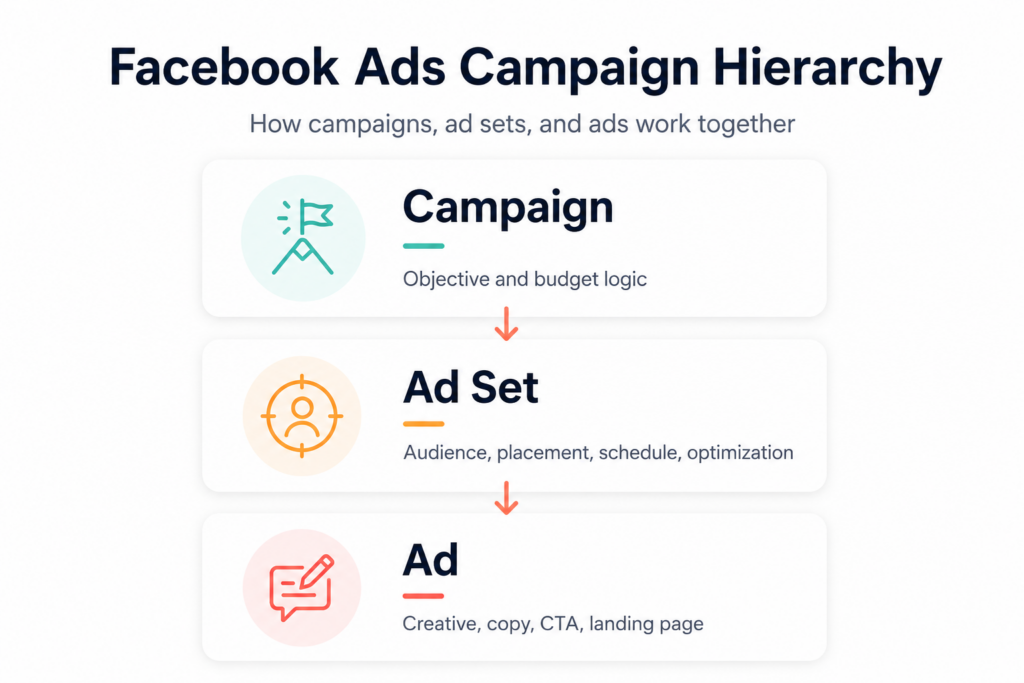
Facebook Ads campaign structure is the way your ad account is organized across three levels: Campaign, Ad Set, and Ad. Each level controls a different part of your advertising setup, and decisions made at one level flow down to everything below it.
| Level | What it controls | Simple meaning |
|---|---|---|
| Campaign | Objective, campaign type, campaign-level budget settings | What you want Meta to achieve |
| Ad set | Audience, placements, schedule, optimization event, attribution, and budget if using ad set budgets | How Meta delivers the ads |
| Ad | Creative, copy, headline, CTA, format, destination, and product or catalog assets | What people actually see |
Think of it like a decision tree. The campaign sets the goal. The ad set gives Meta the delivery conditions. The ad gives Meta the message to show. The structure directly affects optimization, delivery, budget flow, and reporting.
Why Facebook Ads campaign structure affects performance?
Poor structure creates problems that look like targeting or creative failures when the real issue is underneath both.
When budget is scattered across too many campaigns and ad sets, each container gets too little data to learn from. Ad sets that are too similar to each other compete for the same delivery, which drives up CPMs without improving results. Testing and scaling get mixed together, so a new experiment can destabilize a working winner, and a working winner can mask the performance of a new test. Reports become harder to trust because the numbers are fragmented across dozens of places.
Meta’s own guidance warns that unnecessary edits during the learning phase can reset learning and delay optimization. It also recommends consolidating similar ad sets because each similar ad set gets fewer opportunities to learn when they run simultaneously at small budgets.
The real issue: More campaigns do not always mean more control. Sometimes, they just create more places for budget to get stuck and more confusion about what to fix.
When structure breaks down, four problems follow consistently:
- Budget gets scattered and learning slows across every active ad set.
- Reports become fragmented and harder to act on.
- Scaling decisions become emotional because data signals are unclear.
- Teams spend time managing structure instead of improving creative and strategy.
The three levels of Facebook Ads structure
Campaign level: choose the business goal
The campaign level has one job: set the objective. Meta offers six campaign objectives in 2026: Awareness, Traffic, Engagement, Leads, App Promotion, and Sales. The objective you choose tells Meta which user behavior to optimize toward, and it builds an entirely different predictive model depending on what you select.
If you select Sales and optimize for the Purchase event, Meta looks for users who are likely to complete a purchase. If you select Traffic because it appears cheaper, Meta looks for users who are likely to click links, which might be a completely different population. Those clicks will cost less. Most of them will not buy. The campaign objective cannot be corrected by anything you do below it, which makes it the most consequential single decision in your account structure.
A campaign can serve different roles across an account: prospecting, retargeting, creative testing, scaling, lead generation, catalog sales, a specific offer, a specific market, or an Advantage+ sales setup. The role should be clear before the campaign is created.
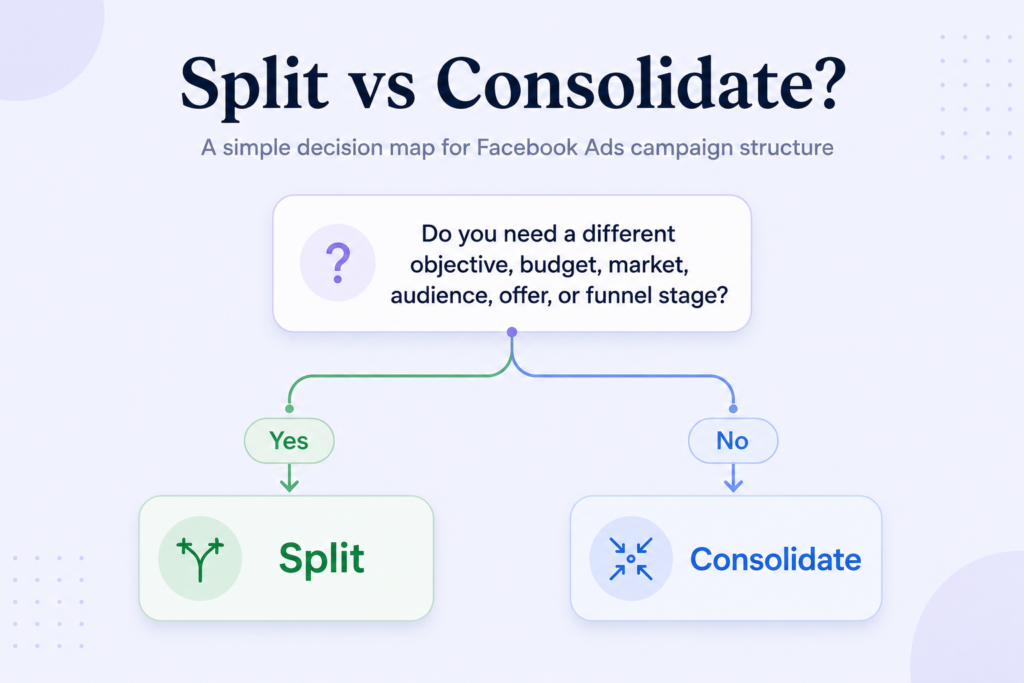
Create a separate campaign when: the objective, budget logic, market, offer, funnel stage, campaign type, or reporting decision is meaningfully different from existing campaigns.
If you cannot explain the job of a campaign in one sentence, the structure probably needs cleaning. The Facebook Ads Objectives guide covers how to choose the right objective for each campaign role.
Ad set level: control delivery conditions
The ad set level controls the delivery conditions: audience, location, age and gender if used, placements, schedule, optimization event, attribution setting, bid strategy, and budget in ABO setups. This is where many advertisers overcomplicate their structure by splitting ad sets for every interest hypothesis, every small audience idea, or every variable they want to watch, even when the budget cannot support those splits.
In 2026, the ad set level has changed more than any other level. Detailed interest-based targeting was formally deprecated on January 15, 2026. Audiences built with old interest targeting before October 2025 no longer deliver. Advertisers now work primarily with broad targeting, custom audiences from their own Pixel and CRM data, and Advantage+ Audience, which lets Meta’s algorithm expand beyond any seed audience you provide.
This means the ad set is no longer primarily about audience precision. It is about giving Meta the right starting signal and defining the delivery parameters around it.
Before creating a new ad set, ask:
- Is the audience meaningfully different from existing ad sets?
- Does the budget need separate control?
- Is the optimization event different?
- Is the market or country different?
- Is the funnel stage different?
- Will this split make reporting clearer?
- Does this ad set have enough budget to learn on its own?
If most answers are no, consolidate. The Facebook Ad Targeting guide covers how to build audiences correctly after the January 2026 changes.
Ad level: test the message people see
The ad level is where creative, copy, format, offer, and destination are tested. This is the level where variation belongs, not spread across ad sets, but concentrated inside them. Multiple ads within a single ad set give the algorithm options to rotate toward whichever creative performs best for your objective.
Good ad structure is not about adding many similar variations. It is about testing meaningfully different messages.
Weak ad setup:
Ad 1: 20% off image
Ad 2: Same 20% off image with a different background
Ad 3: Same offer with slightly different copy

Better ad setup:
Ad 1: UGC angle
Ad 2: Product demo angle
Ad 3: Testimonial angle
Ad 4: Problem-solution angle
Ad 5: Offer or urgency angle
Ten ads saying almost the same thing are not ten real tests. A stronger ad setup gives Meta different creative angles to work with, while giving you clearer insight into what message is actually moving people.
What changed in Facebook Ads structure in 2026?
A lot of older Facebook Ads structure advice still tells advertisers to create separate ad sets for every interest, lookalike percentage, placement type, age range, and retargeting window. That advice can still apply in specific controlled scenarios, but it is no longer the default best practice for most accounts.
Meta has moved toward more automation, broader delivery, Advantage+ options, and consolidated learning. The role of the advertiser has shifted from manually controlling every variable to designing a structure that Meta can learn from and that a team can actually understand.
- Old way of thinking: Create many ad sets for every interest and audience hypothesis.
Better way now: Consolidate similar delivery conditions and use creative, offer, and funnel logic to guide structure. - Old way of thinking: Control every placement manually from the start.
Better way now: Use automated placements unless there is a clear creative, brand safety, or reporting reason not to. - Old way of thinking: Test audiences first, then figure out creative.
Better way now: Test creative angles, hooks, offers, and landing page fit more intentionally. Audience control is increasingly handled by the algorithm. - Old way of thinking: More campaigns means more control.
Better way now: More campaigns means more fragmentation. Structure should be as simple as the account’s goals allow.
Simple vs segmented Meta Ads campaign structure
There is no single right structure for every account. Simple and consolidated structures are usually better for smaller budgets and newer accounts. Segmented structures are useful when there are meaningful differences in product, market, funnel stage, or testing logic. Most growing accounts end up using a hybrid.
| Structure | Best for | Main risk |
|---|---|---|
| Simple / consolidated | Small budgets, new accounts, broad delivery, Advantage+ setups | Less manual control over individual ad set performance |
| Segmented | Multiple products, markets, funnel stages, or distinct testing systems | Can fragment learning signal if overdone |
| Hybrid | Most growing accounts with clear campaign roles | Needs naming discipline and regular auditing |
The best structure is not the one with the most layers. It is the one where every campaign and ad set has a clear job.
The learning phase rule that determines how many ad sets you can run
Meta needs approximately 50 optimisation events per ad set per week to exit the learning phase. This is the most important structural constraint in Facebook Ads, and most advertisers violate it by splitting their account too many ways.
A quick calculation: take your expected weekly conversions and divide by 50. That is the maximum number of ad sets that can realistically exit learning simultaneously at your current volume. A campaign generating 100 purchases per week can support two ad sets. Running five ad sets on that same campaign means each receives an average of 20 events — all five stay in perpetual learning, CPMs stay elevated, and the performance data you see reflects learning-phase instability rather than real campaign performance.
The Budget Optimization guide covers the learning phase in full, including minimum budget calculations based on your expected CPA and conversion rate.
Common Facebook Ads campaign structures by goal
These are practical starting points, not rigid templates. Adapt them to your budget, product, and goals.
Small budget structure
For new accounts, founders, small ecommerce brands, and service businesses that do not yet have enough budget to support multiple campaigns.
Sales or Leads Campaign
  Ad Set 1: Broad / Advantage+ Audience
    Ad 1: Product benefit or service benefit
    Ad 2: UGC or founder-style angle
    Ad 3: Testimonial or proof angle
    Ad 4: Offer or urgency angle
Optional only when there is enough warm traffic to support it:
Retargeting Campaign
  Ad Set 1: Combined warm audience (website visitors + social engagers)
    Ad 1: Social proof
    Ad 2: Offer reminder
Best for: New accounts, simple offers, low to medium budgets, brands that need learning signal.
Why it works: It concentrates budget into one container and gives Meta a clearer conversion signal. Creative variation at the ad level replaces audience fragmentation at the ad set level.
When not to use it: When multiple markets, product categories, or funnel stages genuinely need separate budgets and reporting.
Ecommerce hybrid structure
For D2C brands and ecommerce stores with enough purchase data to support multiple campaign types.
Advantage+ Sales Campaign
  Role: Main sales delivery and broad scaling

Manual Sales Campaign
  Role: Specific product, offer, or creative-angle test

Retargeting Campaign
  Role: Cart abandoners, product viewers, and warm visitors

Creative Testing Campaign
  Role: New hooks, formats, UGC, and offer angles
Best for: D2C and ecommerce brands with catalog-based selling and enough conversion volume to support more than one campaign.
Why it works: It combines automation for scale with manual control for specific tests and warm audience messaging. Advantage+ handles broad delivery efficiently while manual campaigns give you a controlled lane for specific hypotheses.
When not to use it: When the account has very little conversion data, or the budget cannot realistically support learning phase requirements across multiple campaigns.
Not every ecommerce account needs all four campaigns from day one. Start with the Advantage+ campaign, add retargeting once warm audience volume is sufficient, and introduce the testing campaign only when you have regular creative production.
Lead generation structure
For service businesses, agencies, SaaS, and high-ticket offers where lead quality matters as much as lead volume.
Lead Campaign
  Ad Set 1: Broad / Advantage+ Audience
    Ads: Lead magnet angle, pain-point angle, proof angle

Website Conversion Campaign
  Ad Set 1: High-intent audience or broad audience
    Ads: Landing page conversion ads

Retargeting Campaign
  Ad Set 1: Website visitors, form openers, and engaged users
    Ads: Case study, objection handling, consultation CTA
Best for: Service businesses, SaaS, agencies, high-ticket offers, and consultation or demo-led sales processes.
Why it works: It separates lead capture, website intent, and warm follow-up instead of forcing all lead activity into one campaign. Instant form leads and website leads often differ significantly in intent and follow-up requirements, so running them separately gives you cleaner data on which approach produces better downstream results.
Do not judge lead generation structure only by cost per lead. A campaign that produces fewer but better leads may be significantly stronger than a campaign that fills your CRM with cheap, low-intent submissions. The real analysis should include lead quality, booked calls, pipeline value, or revenue — not only cost per lead.
When not to use it: When there is no follow-up system to evaluate lead quality beyond cost per lead.
Creative testing structure
For accounts with regular creative production that need a controlled testing lane separate from scaling campaigns.
Creative Testing Campaign
  Ad Set 1: Broad testing audience
    Ad 1: Founder angle
    Ad 2: UGC angle
    Ad 3: Product demo angle
    Ad 4: Problem-solution angle
    Ad 5: Offer or urgency angle
Best for: Accounts with regular creative production, brands scaling spend, and teams that want cleaner testing data without disturbing proven winners.
Why it works: A dedicated testing campaign gives new creative angles a controlled place to prove themselves without risking the stability of your scaling campaigns. Once a creative angle gets enough signal, it can be moved into the scaling setup carefully.
When not to use it: When the account budget is too small to support a separate testing campaign alongside a main campaign.
Creative testing should be organized by angles, not random variations. Avoid stuffing too many ads into one ad set, and give tests enough budget and time to get meaningful delivery before drawing conclusions.
Retargeting structure
For accounts with enough warm audience volume to justify a dedicated campaign.
Larger accounts:
Retargeting Campaign
  Ad Set 1: Website visitors (30 days)
  Ad Set 2: Product viewers and add to cart
  Ad Set 3: Instagram and Facebook engagers
Smaller accounts:
Retargeting Campaign
  Ad Set 1: Combined warm audience
    Website visitors + social engagers + cart abandoners
Best for: Ecommerce brands with meaningful Pixel data, longer buying cycles, and higher-ticket products where warm audiences convert at meaningfully different rates.
Why it works: Segmented retargeting lets you speak differently to people based on how close they are to converting. Someone who started checkout needs a different message from someone who visited your homepage three weeks ago.
When not to use it: When audience segments are too small. Below 1,000 users, Meta cannot serve ads to a custom audience at all. If each segment is small, combine them into one warm audience ad set rather than creating several that cannot deliver.
The full retargeting strategy including tier structure, frequency management, and creative approach by funnel stage is covered in the Facebook Ads Retargeting guide.
Scaling structure
Scaling is not only increasing budget. It is protecting proven winners while testing new ideas in a separate, controlled lane.
Scaling Campaign
  Ad Set 1: Broad / Advantage+ Audience
    Ad 1: Proven winner
    Ad 2: Proven winner
    Ad 3: Proven winner

Testing Campaign
  Ad Set 1: Broad testing audience
    New creative angles and offers
Do:
- Scale proven ads with stable delivery.
- Give winners time to perform before touching them.
- Keep new experiments in a separate testing campaign.
- Review performance over a meaningful window, not a single day.
Do not:
- Add every new creative to your best-performing campaign.
- Make daily edits that reset the learning phase.
- Duplicate campaigns without a clear structural reason.
- Scale a campaign before it has exited learning and shown stable results.
Campaign budget vs ad set budget
Campaign budget means Meta distributes one budget across all ad sets in the campaign. Ad set budget means you set and control spend at each individual ad set level. Meta’s Advantage+ campaign budget is a version of campaign budget where the algorithm manages distribution automatically across ad sets for the best overall result.
| Budget setup | Best for | Watch out for |
|---|---|---|
| Campaign budget | Scaling, similar ad sets, automated spend distribution | One or two ad sets may take most of the spend |
| Ad set budget | Controlled tests, strict budget splits, separate markets or funnel stages | Too many ad sets can fragment learning |
Use campaign budget when you trust Meta to distribute spend toward the best opportunities. Use ad set budget when the business reason for controlling a specific allocation is stronger than the benefit of automation.
Specific cases where ad set budget makes sense: when you need to guarantee your retargeting campaign receives budget even if prospecting is outperforming it, when you are running a controlled creative or audience test and need equal spend across ad sets for fair comparison, or when different markets or product categories need separate spending floors.
The full decision framework including the hybrid testing approach (ABO for testing, CBO for scaling) is in the ABO vs CBO guide.
Manual campaigns vs Advantage+ campaigns
This is not a binary choice. A well-structured account can use both, and the decision should be based on what each campaign role actually needs.
Manual campaigns are more useful when:
- You need controlled creative or audience testing with clean data
- You are targeting a specific product, offer, or market
- Retargeting needs strict audience and budget control
- Lead generation workflows require funnel separation
- Analysis requires cleaner splits between campaign types
Advantage+ campaigns are more useful when:
- You are optimizing ecommerce sales at scale
- You want Meta to find buyers across a wider delivery space with less manual input
- The account has strong conversion signal from a well-configured Pixel
- You want faster campaign setup with automated optimization across audiences, placements, and creative
A hybrid structure works well for most growing accounts:
Advantage+ Sales Campaign
  Role: Main sales delivery and scaling

Manual Sales Campaign
  Role: Specific product, offer, or creative angle test

Retargeting Campaign
  Role: Warm audience conversion with controlled messaging

Creative Testing Campaign
  Role: New creative ideas before entering the main setup
Each campaign has a job. Advantage+ handles broad automated scale. The manual campaign gives you a controlled lane for experiments that need clean data. Retargeting ensures warm audiences get the right message with the right frequency. Testing keeps new ideas separate from proven revenue drivers.
Advantage+ does not remove the need for structure. It changes what good structure looks like.
Common campaign structure mistakes
Mistake: Creating too many campaigns too early Why it hurts: It splits budget, slows learning across every campaign, and creates more places to monitor without improving decision quality. Better approach: Start with fewer campaigns and add complexity only when the account has enough budget, conversion signal, and a genuine business reason for the split.
Mistake: Splitting similar audiences into separate ad sets Why it hurts: Similar ad sets compete for the same delivery and reduce the conversion events available to each. Neither exits learning properly. Better approach: Combine similar audiences unless the budget, funnel stage, market, or reporting need is genuinely different.
Mistake: Mixing testing and scaling without a plan Why it hurts: New experiments can destabilize working winners, and winning ads can hide the real performance of new tests by absorbing most of the budget. Better approach: Use a dedicated testing lane when the account has enough budget, then move proven winners into the scaling campaign carefully and deliberately.
Mistake: Using the wrong campaign objective Why it hurts: Meta optimizes for the action you select. A Traffic campaign sends people to your site. A Sales campaign sends buyers. These are not the same outcome, and the wrong objective cannot be fixed at the ad set or ad level. Better approach: Choose the objective that matches the actual business result you need, not the one that produces cheaper surface metrics.
Mistake: Judging results without enough signal Why it hurts: Early results during the learning phase are often misleading. Pausing or editing campaigns before they have enough conversion data resets learning and extends the instability. Better approach: Review results over a meaningful window, avoid unnecessary edits during learning, and use the 50-events-per-week threshold as your guide for when data is reliable.
Mistake: Over-controlling placements too early Why it hurts: Manual placement restrictions reduce delivery opportunities if there is no strong performance, creative, or brand safety reason for them. Better approach: Use automated placements unless creative format, brand safety, or clear performance evidence gives you a reason to narrow.
Mistake: Poor naming conventions Why it hurts: Bad naming makes reporting painful as campaigns multiply, and makes it impossible for anyone new to the account to understand what is running and why. Better approach: Name campaigns to show objective, funnel stage, market, and campaign type. Name ad sets to show audience type and budget method. Name ads to show creative format and angle.
How to choose the right campaign structure for your Meta Ads?
Before creating or restructuring campaigns, work through this checklist. If most answers point toward no, you probably do not need another campaign or ad set.
Before creating a new campaign, ask:
- Is the objective different from existing campaigns?
- Is the budget logic meaningfully different?
- Is the market or geography different?
- Is the offer or product category different?
- Is this a testing campaign or a scaling campaign — and does that role need its own container?
- Is the funnel stage different?
- Will this split make reporting clearer and more actionable?
- Does Meta have enough conversion signal to support this additional split?
- Can someone else on the team understand this structure without a lengthy explanation?
The last question is underrated. A structure that only the person who built it can navigate is a structure that will cause problems every time the account is handed over, reviewed, or scaled.
How to audit your current Meta Ads campaign structure?
Campaign structure is not something you set once and leave. It should be reviewed when the account changes in any significant way.
Audit your structure when:
- Monthly spend increases significantly
- Performance drops without an obvious creative or audience cause
- New products, offers, or markets are being added
- Creative production volume increases
- Advantage+ starts notably outperforming or underperforming manual campaigns
- Retargeting frequency climbs without a creative refresh solving it
- Reports have become hard to explain to a client or team member
- Campaign names no longer reflect what is actually running
Questions to ask during the audit:
- Are campaigns grouped by objective, or were they created randomly over time?
- Are any ad sets too similar and likely competing for the same delivery?
- Is budget pooling heavily into one ad set while others barely spend?
- Are some ads getting no delivery at all?
- Are testing campaigns separate from scaling campaigns, or are new tests being added directly to the main campaign?
- Are retargeting audiences large enough to deliver?
- Is the account still using interest-heavy structures that are no longer effective after the January 2026 targeting changes?
- Does every active campaign have a clear role that can be explained in one sentence?
If you cannot explain the job of a campaign in one sentence, the structure probably needs cleaning.
For a full structured account review that goes beyond campaign structure into tracking, creative, and targeting, the Facebook Ads Audit guide provides a step-by-step checklist.
How Vaizle AI helps you analyze campaign structure?
Most advertisers do not struggle because they cannot see their data. They struggle because Ads Manager shows too much data without telling them what to fix first. A messy account structure makes that problem worse because there are more rows, more campaigns, and more numbers to interpret, but less clarity about where the actual issue is.
Vaizle AI connects to your live Meta Ads account and lets you ask plain-English questions across campaigns, ad sets, and ads without manually rebuilding breakdowns in Ads Manager. Instead of cross-referencing spend, conversions, frequency, and learning status across dozens of campaigns, you can ask directly what needs attention and get a clear answer grounded in your actual account data.
Questions you can ask Vaizle AI about your campaign structure:
- Which campaigns are spending without producing conversions?
- Are any of my ad sets competing with each other for the same audience?
- Which campaigns should I consolidate, and why?
- Is my Advantage+ campaign outperforming or underperforming my manual campaigns right now?
- Which ad sets are stuck in the learning phase?
- Is my retargeting frequency getting too high?
- Which campaigns should I pause, scale, or restructure based on the last 30 days?
Suggested prompt for Vaizle AI:
"Analyze my Meta Ads campaign structure and tell me which campaigns or ad sets should be consolidated, separated, paused, scaled, or reviewed."
Instead of manually jumping between campaigns, ad sets, and reporting breakdowns, you can ask Vaizle AI to analyze the structure and turn the messy parts into a clear action list.
