





ROAS drops in Meta ads aren’t random. They happen because something in your funnel stopped working the way it used to.
So, the problem here is most advertisers react before they actually understand – why did their Meta ads suddenly stop getting returns. They quickly churn out more creatives, adjust audience targeting, or even pause campaigns. But none of this works because you don’t actually know what broke.
If you’ve been there as well, you’ve landed at the right page. For this blog, I have interviewed an experienced agency owner & specifically asked for pointers that most agencies don’t reveal to their clients.
So, let’s get started. We will first understand whether your ROAS dip is actually worth your concern and then we will cover breakdowns that will quickly connect your Meta ads ROAS drops to overall business strategy.
PS: If you’re a Meta ads beginner, you might want to start with basics. We’ve put together a detailed Meta Ads guide that will help you out.
Let’s clear one myth first: Ads don’t stop performing overnight. Performance degrades in stages. You miss out on initial signals, and when you come back to the dashboard, you notice a sudden drop. But that’s simply because you’re not noticing when the performance starts dropping.
When you run Meta ads, first your audience gets saturated. People who were going to convert already converted. The remaining pool is less interested. Then your creative loses effectiveness. The same message that grabbed attention three weeks ago now gets scrolled past.
Somewhere in between, Meta’s algorithm shifts your ad spend. This means Meta starts finding cheaper clicks or impressions in other placements, age, gender, or platforms.
All of this combined, makes the aggregate ROAS looks bad, but the decline has been building for weeks.
The mistake most people make is looking at overall campaign performance. That hides where the actual problem started. You see “campaign ROAS dropped” but you don’t see:
Without that breakdown, you’re randomly start fixing the wrong thing. Or you start fixing everything at once, which resets learning phase and makes the problem worse.
Let’s understand this in detail.
A ROAS drop isn’t just a number changing in Ads Manager. It’s a signal. And if you ignore it, the impact compounds. When you don’t catch the drop early, you keep spending ad budget into the same leaking funnel.
But wait, there’s other side as well – when you react too fast, you create a different problem. You reset Meta’s learning. The algorithm loses optimization data, which means your campaigns go back to square one.
CPMs go up during the learning phase. Conversion rates become unstable. You’re paying to re-teach the algorithm what it already knew.
The better approach sits in the middle. Catch the Meta ads ROAS decline early enough to save your ad budget. But diagnose the specific problem before changing anything. When you identify the specific failure point, you can fix that one thing. Everything else keeps running with its existing learning intact.
This is why early detection matters for Meta ads. Not so you can react faster. So you can respond more precisely.
The longer a problem runs, the harder it becomes to isolate. Did ROAS drop because of creative fatigue, or audience saturation, or a broken landing page? When everything’s been declining for a month, you can’t tell. You end up changing everything and hoping something works.
But when you catch it in the first week, the cause is usually obvious. One metric moved. One stage broke. Fix that, and performance recovers.
Before you change anything, confirm the Meta ads drop is real. For new campaigns – don’t judge performance based on one day or even a few days. Depending on your niche, purchase decisions can take time for your target audience.
Best way to confirm ROAS drop is to start by comparing the last seven days to the previous seven days. Or two weeks to two weeks if your volume is lower. Use the same attribution window for both periods. But remember, don’t switch from 7-day click to 1-day click halfway through. That creates a fake decline.
Then cross-check Meta’s numbers with your backend. Your CRM, Google Analytics, Shopify—whatever you use to track actual conversions. Sometimes Meta shows a ROAS drop while your backend still shows strong revenue. That’s an attribution issue, not a performance issue.
The best way to catch drops early is to monitor Meta ads trends, not just snapshots.
You need to see the pattern. Is performance staying flat? Declining gradually? Improving? That trend tells you more than any single data point.
Monitor your weekly ROAS trends
Find how your ROAS is moving!
Once you’ve figured out the ROAS drop is real, you can start diagnosing the reasons. Let’s look at two breakdowns that will go beyond Meta dashboard and can impact your ROAS.
Most campaigns send traffic to multiple page types. Homepage, product pages, category pages, landing pages. And each page type serves a different intent level. For example:
The problem is most people look at blended performance. They see overall ROAS or CAC across all traffic and assume everything is performing equally.
But they don’t understand that one destination might be converting well. Another might be burning budget. When you track blended ROAS number, you can’t really spot that.
So, your job is to separate performance by destination. Figure out which page type is actually working. Then send more traffic there and less traffic to the pages that aren’t converting.
Go to Ads Manager. Select your campaigns. Click breakdown, then select “By Destination.” This shows performance split by URL. You’ll see a list of all the pages your ads are sending people to.
Export that data. Then group the URLs by page type. Homepage URLs in one bucket. Product page URLs in another. Landing page URLs in a third.
For each bucket, calculate three things:
Remember to use a consistent conversion metric. Purchase per landing page view. Lead per landing page view. Add to cart per landing page view. Whatever your goal is.
Now compare the buckets.
If product pages have the best conversion rate, send more traffic there. If your homepage converts better, figure out why and apply those elements to your other pages. If landing pages win, scale budget to campaigns using those pages.
One more thing. Don’t compare different traffic types. Cold traffic to the homepage will convert worse than retargeting traffic to a product page. That’s expected.
You’re looking for patterns within the same traffic type. Compare cold homepage traffic to cold product page traffic. Compare retargeting across different destinations. Keep it apples to apples.
Once you know which destination works best for each traffic type, adjust your campaigns. Send cold traffic to the pages that educate. Send warm traffic to the pages that convert. Stop wasting budget on destinations that don’t work.
This doesn’t require new ads or new audiences. Just better routing.
Even when you’re sending traffic to the right page, your funnel can still leak. The issue is most people only look at the final metric. ROAS, CAC, cost per purchase. They see that number drop and assume the whole campaign is broken.
But ROAS is the output. It’s the result of multiple stages working together. If one stage breaks, the whole thing breaks. And you can’t fix it without knowing which stage failed.
Break your funnel into checkpoints: Click → Landing Page View → Add to Cart (or Lead) → Purchase (or Qualification)
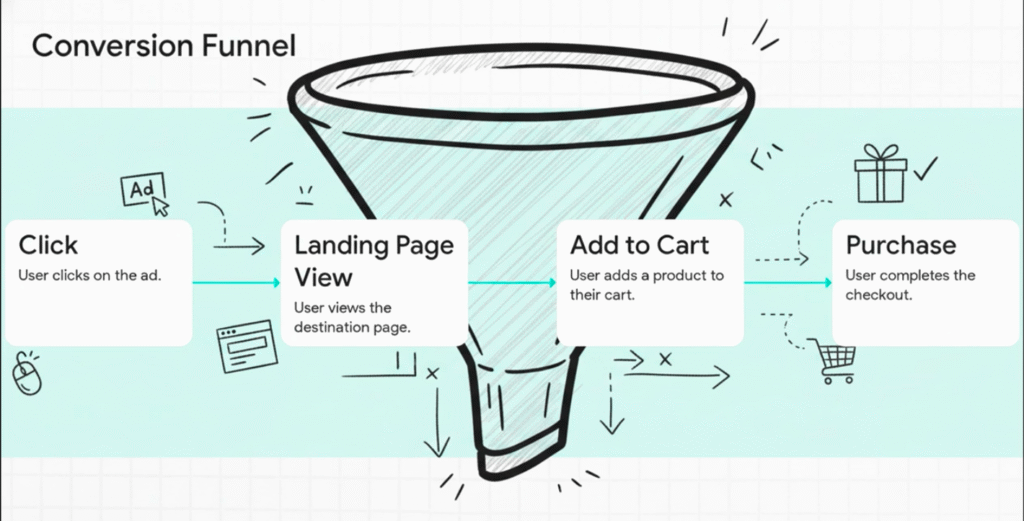
There’s always going to be drop-off between stages. Not everyone who clicks will view the page. Not everyone who views will add to cart. Not everyone who adds to cart will purchase.
Now, you’re looking for the stage where drop-off is abnormally high. The point where traffic is dying for reasons that don’t make sense.
That’s your bottleneck. Fix that first.
Scenario 1: High Clicks, Low Landing Page Engagement
If people are clicking but not engaging with the page, that’s a curiosity click problem. The ad was interesting enough to get attention. But the landing page didn’t deliver on what the ad promised.
Common causes:
Fix the message first. Make sure the page reinforces what the ad said. Then fix the layout. Make sure the most important information is visible without scrolling. Then add credibility. Reviews, testimonials, trust badges.
The ads are working. They’re generating interest. The page is failing to convert that interest into action.
Scenario 2: Strong Engagement, Weak Conversions
If people are reading, scrolling, and spending time on the page but not converting, that’s friction or uncertainty.
They’re interested. They want what you’re offering. But something is stopping them from taking action.
Common causes:
Your job is to remove fear and reduce effort. Make it obvious what they’re buying. Make the checkout as simple as possible. Show them what happens after they order. Offer guarantees that reduce risk.
Scenario 3: Strong Add to Carts, Weak Purchases
If people are adding to cart but not completing checkout, the problem is at the final step.
Common causes:
This is often the easiest fix. Reduce checkout fields. Add more payment options. Show shipping costs earlier in the funnel. Enable guest checkout. Small changes here can recover significant ROAS because you’re fixing the last step before conversion.
Identify which stage has the worst drop-off. Fix that stage. Run the funnel again in a few days.
Small improvements at the bottleneck create bigger gains than trying to fix everything at once.
You don’t optimize the whole funnel. You fix the weakest link first. Then move to the next weakest link. Then the next.
That’s how you recover ROAS without resetting your campaigns or starting over.
Running these breakdowns manually works. But it takes time. You have to export data, organize it in spreadsheets, calculate conversion rates, compare time periods, identify patterns.
For one campaign, that’s manageable. For five campaigns across multiple ad accounts? It becomes a full-time job.
That’s why we built Vaizle AI.
Vaizle is a Meta Ads analytics agent that automatically runs these breakdowns for you. It tracks your ROAS trends, identifies which destinations are underperforming, shows you where your funnel is leaking, and flags problems before they compound.
Instead of spending hours pulling reports, you can simply ask for ROAS fix plan and it will let you know the best possible path.
Best part? Vaizle AI is built by a team of performance marketers. So, you can actually expect it to behave like a real Meta Ads analyst.
Here are some tasks Vaizle AI can do within seconds:
And this is just the tip of iceberg. You can further ask complicated questions.
As such, Vaizle AI helps you stop reacting to problems after they’ve already cost you money. You see them coming and fix them before they compound.
Meta ads decline when one part of the system breaks. Audience quality, landing experience, funnel flow, or delivery shifts.
The worst thing you can do is react emotionally. Pause everything. Change everything. Churn out new creatives.
The better move is to diagnose first.
Check if the drop is real. Identify which lever moved. Find where the leak is—destination or funnel stage.
Once you know why performance slipped, fixing it becomes easier and faster.
That’s how you stop wasting budget, avoid resetting learning, and prevent one bad week from turning into a bad quarter.
The next time ROAS dips, don’t panic. Trace the drop. Fix the specific point of failure.
Meta rewards consistency and clarity. The advertisers who win aren’t the ones who react fastest. They’re the ones who diagnose best.
Don’t judge performance on one day. Compare last seven days to the previous seven using the same attribution window. If the decline is consistent, not just a weekend dip, it’s real.
Not usually. Algorithm shifts create temporary volatility but rarely cause sustained decline. Most drops come from audience saturation, message mismatch, or funnel leaks.
No. Pausing resets learning and raises costs when you restart. Diagnose the weakest link first—CPM, CTR, conversion rate, or funnel stage—and fix that without erasing data.
CTR means the ad got attention. It doesn’t mean the landing page or offer matched that attention. You can have high CTR and low conversion if the message breaks after the click.
Run a destination breakdown—homepage vs product page vs landing page—and a funnel review—click to view to cart to purchase. The biggest drop-off shows the bottleneck.
Creative fatigue contributes when audiences saturate or messaging stops resonating. It’s a factor but rarely the only cause.

Purva is part of the content team at Vaizle, where she focuses on delivering insightful and engaging content. When not chronically online, you will find her taking long walks, adding another book to her TBR list, or watching rom-coms.
Copyright @VAIZLE 2026
